Leopold's Trillion-Dollar Cluster Prediction: Fully Realized Two Years Later
In June 2024, Leopold Aschenbrenner published "Racing to the Trillion-Dollar Cluster," predicting the AI landscape two years ahead while others debated GPT-4.
In June 2024, Leopold Aschenbrenner published "Racing to the Trillion-Dollar Cluster." At that time, many were still debating how powerful GPT-4 was, but he had already seen the world two years into the future.
About Leopold Aschenbrenner: As a senior researcher at OpenAI, Leopold possesses deep engineering and strategic insights into AI system scaling, compute infrastructure, chip supply chains, and large-scale computing. In the intersection of AI infrastructure and geopolitics, perhaps no one sees more clearly than he does. His article "Racing to the Trillion-Dollar Cluster" not only accurately predicted the trajectory of AI hardware demand but, more importantly, elevated the AI competition from a "technology race" to the level of an "industrial system race" and "national competition." This became the core framework for understanding the AI investment wave of 2024-2026.
It is now May 2026. Looking back at this article, all his core predictions have been validated:
- Electricity has become the biggest bottleneck ✅
- HBM and advanced packaging have become critical choke points ✅
- AI investment has escalated from the tech sphere to the level of industrial mobilization ✅
- Energy, infrastructure, and manufacturing companies have soared ✅
Let's see what this "AI Infrastructure Prophet" actually wrote back then.
1. What were his core predictions at the time?
Leopold's assessment in 2024: AI competition has evolved from a model race into an industrial system race.
He argued that what determines the ceiling of AI is no longer algorithms and talent, but rather:
- The ability to continuously secure increasingly larger training clusters
- The ability to build enough data centers
- The ability to obtain sufficient electricity [2026 Validation: Fully Realized]
- The ability to expand sufficient advanced chip production capacity [2026 Validation: Major HBM/CoWoS Shortages]
- The ability to keep this infrastructure within the US or allied systems [2026 Validation: Geopolitical Competition Heats Up]
In other words, the constraints have shifted from the software world to energy, manufacturing, capital expenditure, and geopolitics. Two years later, this statement looks like an ironclad law.
2. What did he predict for 2026?
Leopold extrapolated based on the trend line of 10x growth every two years. Look at his predictions for 2026:
2026 AI Investment Scale: ~$500 billion / year Actual Validation: ✅ Basically on target or exceeding expectations (Major cloud providers' capex is indeed at this scale)
Look at the explosive growth in NVIDIA's Data Center revenue (the most direct evidence of AI investment):
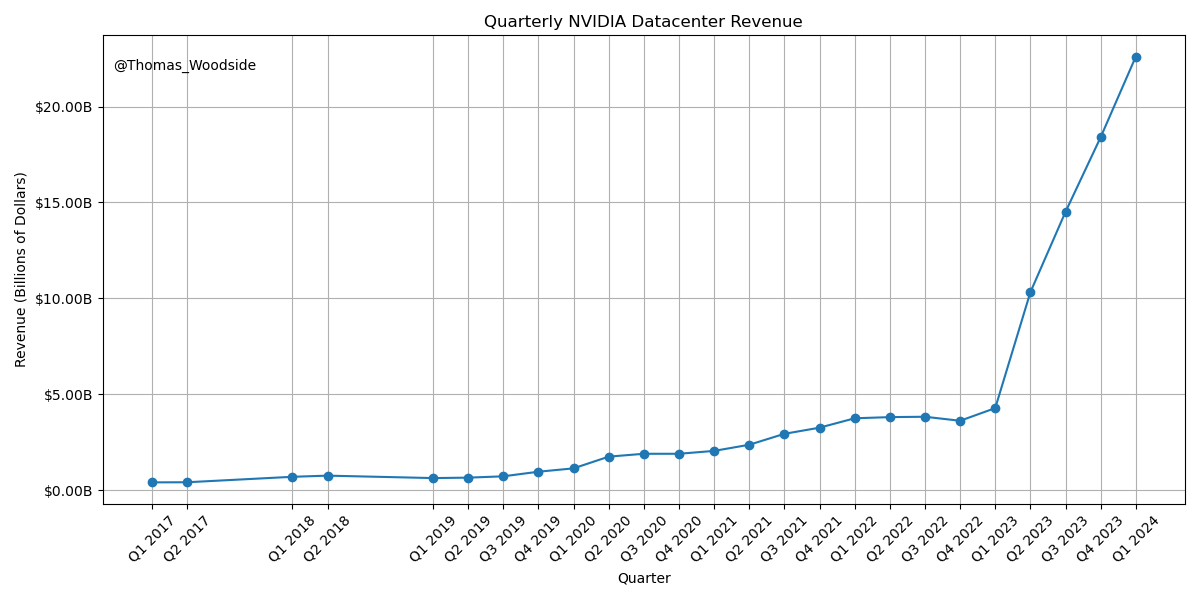
The growth from $14B to $90B fully validates Leopold's theory of industrialized investment.
Here's how he framed the specific data:
- 2022: GPT-4 scale ~ 10,000 H100-equivalent ~ $500 million
- 2024: +1 OOM ~ 100,000 H100 ~ Billions of dollars ✅ Already validated at the time
- 2026: +2 OOMs ~ 1 million H100 ~ Tens of billions of dollars ← We are at this point now
- 2028: +3 OOMs ~ 10 million H100 ~ Hundreds of billions of dollars
- 2030: +4 OOMs ~ 100 million H100 ~ Over $1 trillion
Key Insight: What he emphasized wasn't just the numbers, but a reality:
Training clusters have entered the realm of national infrastructure. AI is no longer about "buying a bunch of GPUs"; it's about consuming electricity resources at the scale of a state.
Look at the surge in Big Tech capital expenditure (the embodiment of industrialization post-ChatGPT):
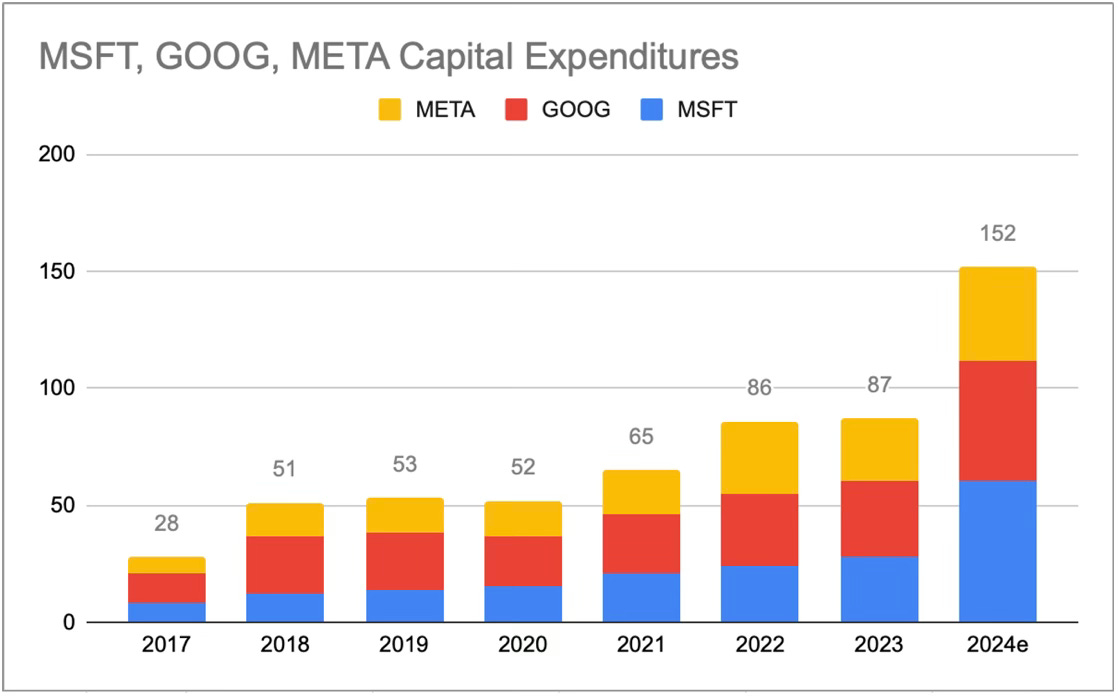
This is what Leopold called "industrial mobilization"—starting in 2023, cloud providers poured money into hard infrastructure, not software.
2. Why did he emphasize "cluster construction cost," not "GPU rental cost"?
Most people discuss model training using a light metric: how much GPU rental a particular model cost. This severely underestimates the real capital expenditure.
The real capital consumption comes from the entire R&D pipeline:
- Architecture exploration
- Small-scale experimentation
- Failed training runs
- Alignment and post-training
- Inference validation and iteration
Furthermore, GPUs themselves are only part of the cost. A large cluster also includes:
- Data center buildings
- Cooling systems
- Power systems
- Network interconnect
- Operations and maintenance
- Capital costs
The core point is: The real figure isn't "how much money a single training run burns," but "how much fixed capital you must invest upfront to reliably secure compute power at this level."
3. By 2030, how large will the total AI investment scale be?
Leopold's overall AI investment estimates are even more aggressive. Look at this data:
2024: Annual AI total investment ~$150 billion Accelerator shipments: 5-10 million H100-equivalent Electricity: 1%-2% of US total TSMC capacity: 5%-10%
2026: Annual AI total investment ~$500 billion Accelerator shipments: Tens of millions Electricity: ~5% of US total TSMC capacity: ~25%
2028: Annual AI total investment ~$2 trillion Accelerator shipments: ~100 million level Electricity: ~20% of US total TSMC capacity: ~100%
2030: Annual AI total investment ~$8 trillion Accelerator shipments: Hundreds of millions level Electricity: ~100% of US total TSMC capacity: ~4x current levels
His point isn't "whether we'll truly reach $8 trillion by 2030," but rather:
Don't just focus on training. AI's true capital throughput capacity lies in the combined sum of "training + inference + multi-player parallel expansion + supporting infrastructure."
4. The biggest constraint isn't chips, but electricity
This is the most insightful part of the entire article. Most people's first thought about AI supply bottlenecks is chip shortages. But Leopold's judgment was:
The truly harder, slower, and more difficult-to-expand bottleneck is actually electricity.
Why? Because:
- 1GW-level data center campuses already require power supply capabilities approaching those of traditional large industrial projects.
- 10GW-level data centers run into state-level resource allocation issues.
- Nuclear power plant construction cycles are too long.
- Large power contracts are usually locked in long in advance.
- Power transmission, grid integration, and permitting are all extremely slow.
A vivid comparison:
- A 10GW cluster is already close to the electricity consumption level of a medium-sized US state.
- A 100GW cluster would represent over 20% of the US's current power generation.
In other words, no matter how much training and inference demand grows, it ultimately boils down to: Where is the electricity? Who can secure it faster? That's where the next wave of AI capability is more likely to land.
Look at the pressure on US power production (this is where Leopold was most prescient):
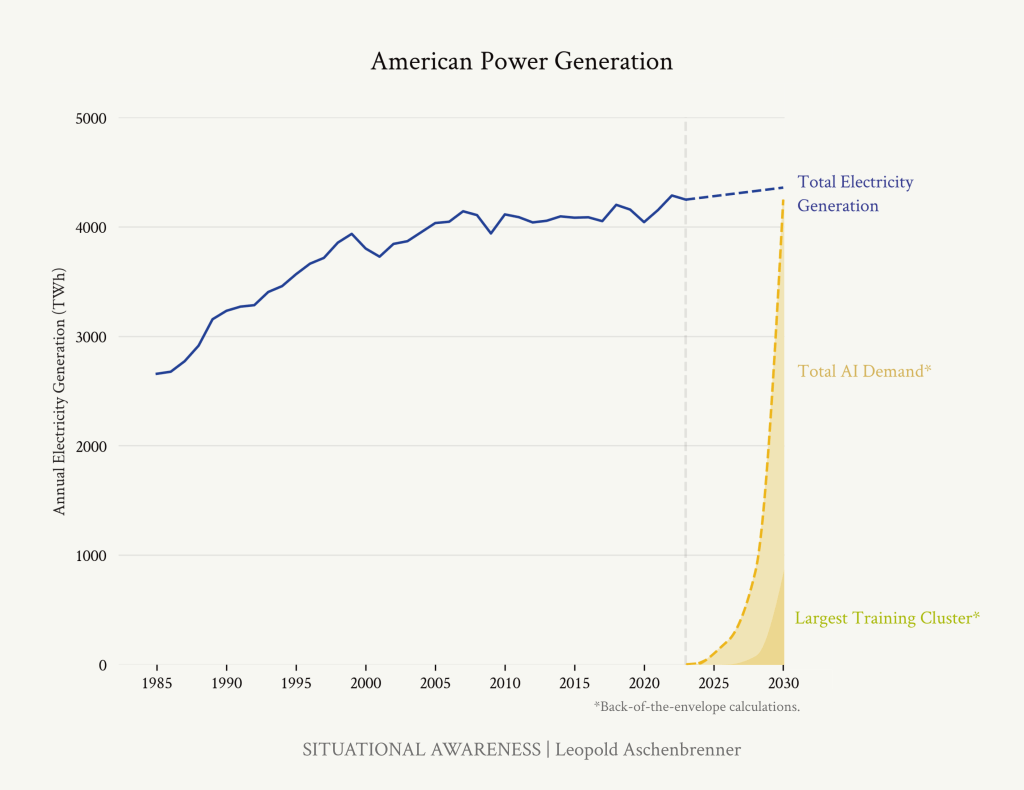
The AI electricity demand curve has shot straight out of historical levels. Leopold saw this in 2024, and now it has become a focal point of policy discussions.
5. The biggest change in the supply chain: From a single GPU to multiple concurrent bottlenecks
Leopold specifically pointed out several key constraint points:
- CoWoS Advanced Packaging: No longer just a "supporting process," but a core constraint for delivering compute power.
- HBM Memory: Has become a substantive bottleneck.
- Network Interconnect: Handles communication between data centers.
- Data Center Supporting Infrastructure: Engineering, land, planning.
The investment insight behind this is:
The easiest points for AI production expansion to get stuck are not necessarily the names the market is most familiar with, but rather those more specialized, less easily replicated intermediate links.
6. Geopolitics: Why he emphasized "Democratic Clusters"
There is a very strong geopolitical thread running through the article:
If the most crucial AGI data centers are built outside the US, especially within uncontrollable political systems, then technological leadership itself could lose its strategic significance.
His concerns are threefold:
- Physical Control: Where the AGI actually runs, which data center, determines who has physical proximity to that system.
- Risk of Political Coercion: Critical infrastructure on foreign soil risks seizure or pressure.
- Risk of Spillover to China: If data center security isn't locked down, the weights and knowledge of the most advanced systems could leak.
Therefore, he ultimately proposed the concept of "Clusters of Democracy," essentially arguing that:
The most critical AI clusters in the future should be built within the United States or among highly trusted allies to the greatest extent possible.
7. Why is this article described as "frighteningly accurate"?
Looking back from 2026, Leopold's most forward-looking judgments at the time can be summarized in five key points:
He was early in elevating the discussion from "computing power demand" to "energy demand." While many were still debating GPU supply, he was already discussing data centers at the 1GW / 10GW / 100GW scale.
He predicted that AI capex would expand along an industrialization path, a trend later validated by the capital expenditure expansions of hyperscalers.
He foresaw the importance of HBM and advanced packaging early on, while the market's attention only gradually shifted from pure GPUs to these supporting segments.
He incorporated geopolitics and national security into AI infrastructure analysis from the start. Today, this increasingly looks like a policy issue.
He didn't stop at writing; he extended his judgments into an investment framework.
8. What insights does this offer for investors?
First, AI investment cannot focus solely on model companies.
Once AI is viewed as industrial mobilization, the research focus must expand to include: GPUs, HBM / DRAM / packaging, data center engineering, power and electricity generation, cooling, networking, geopolitics, and localization efforts.
Second, power constraints mean "whoever deploys first, gets the valuation premium."
AI revenue isn't guaranteed by theoretical demand alone. The real winners will be the companies that secure land, power, equipment, and construction capabilities first.
Third, hyperscaler capex is not ordinary IT spending.
If AI truly enters a phase of national and platform-level competition, cloud providers' capex will behave more like investments in railroads, energy, or telecommunications networks.
Fourth, multiple "not the sexiest, but the most profitable" segments will emerge in the supply chain.
Typical examples include: HBM, advanced packaging, power equipment, cooling, and grid infrastructure. These segments often benefit more from the certainty of capital expenditure than the application layer.
Final One-Sentence Summary
Leopold isn't predicting "which model will be stronger"; he's predicting that once the AGI trend is established, the world will be forced to reorganize its industrial system around computing power, electricity, capital expenditure, and geopolitical security.
After reading this, it becomes difficult to view AI as just another tech sector. You start seeing it as the next wave of national-level infrastructure construction.
References
- Situational Awareness: The Decade Ahead — Official Site — Official site for the series of articles released by Leopold Aschenbrenner in June 2024. The article interpreted here, "Racing to the Trillion-Dollar Cluster," is its second chapter.
- Situational Awareness Full PDF — The complete 165-page original PDF, containing all core arguments including the trillion-dollar cluster, the power bottleneck, and Clusters of Democracy.
Scan with WeChat to share
Screenshot or long-press the QR code to forward it
📌 Related Posts
Leopold Aschenbrenner: AI, Electricity, and the Trillion-Dollar Cluster
Situational Awareness Fund sells most of its public equity portfolio to Citadel, surrendering a successful AI trade amid market reversal.
Leopold Fund Q1 Holdings Analysis: A Full-Scale Bet on AI Infrastructure
A top AI investor, ex-OpenAI researcher Leopold Aschenbrenner, just updated his portfolio—and the data reveals a surprisingly aggressive strategy.
DeepSeek Becomes the Kill Line for LLMs
Will DeepSeek's rock-bottom model pricing eliminate OpenAI and Anthropic? The answer is more complex than that.
Subscribe to Updates
Leave your email to get the latest articles and project updates — or subscribe with your favorite RSS reader
Add 0to1.site/en/rss.xml to RSS readers like Feedly or Inoreader
Comments (no account needed, anonymous welcome)
No comments yet — be the first!