DeepSeek Becomes the Kill Line for LLMs
Will DeepSeek's rock-bottom model pricing eliminate OpenAI and Anthropic? The answer is more complex than that.
Will DeepSeek's rock-bottom model prices kill off OpenAI and Anthropic? The answer isn't that simple.
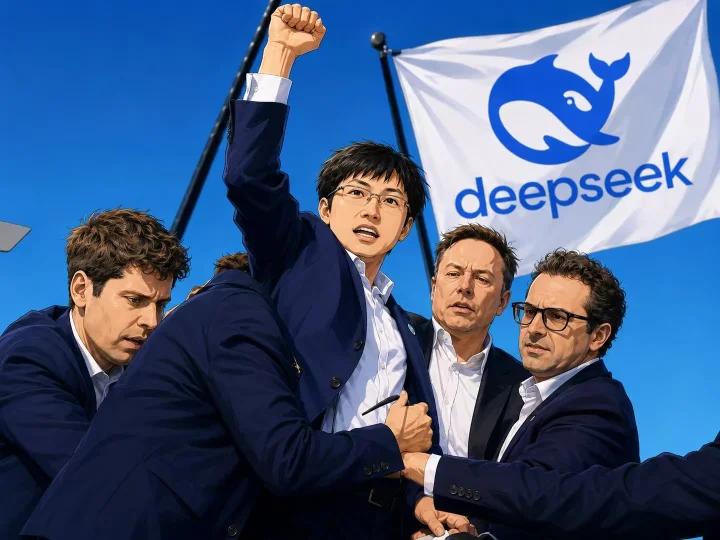
DeepSeek has turned the "kill line" into an industry-wide topic.
Lately, the "LLM kill line" has become a loud talking point.
The intuition isn't hard to grasp: DeepSeek V4 Flash is cheap enough, and its capabilities have crossed the usability threshold for many real-world tasks.
Thus, some argue that the good times for foreign closed-source models are over, and OpenAI and Anthropic will be the first to be "cut down."
I don't see it that way.
The kill line will certainly erode the pricing power of closed-source models, but it's not enough to directly cut down the strongest ones.
What it will first penetrate are those mid-tier models whose capabilities aren't significantly ahead, yet whose prices remain in the old range. Later, it will push a vast amount of white-collar execution work, previously not worth automating, past the ROI tipping point and faster into the replacement zone.
This is where the real sharpness of the "kill line" lies.
Don't Rush to Pronounce OpenAI and Anthropic Dead
First, consider DeepSeek's contradictory situation: on one hand, extremely low prices; on the other, peak-hour surcharges.
As of August 9, 2026, DeepSeek's official pricing page shows that V4 Flash's output price is $0.28 per million tokens.
The page also states that the service will adopt peak/off-peak pricing: from 9 AM to 12 PM and 2 PM to 6 PM Beijing Time daily, the price will be double the regular rate. The specific effective date is subject to official announcement.
SCMP previously reported the same arrangement. DeepSeek's stated reason is to better allocate resources and improve service stability.
The most straightforward explanation is, of course: the cheap model is attracting too many calls, making real-time inference capacity tight during peak hours.
This doesn't mean the low-price strategy has failed. The regular price determines how many tasks it can attract; peak-hour pricing addresses how to allocate limited capacity.
Even at peak prices, V4 Flash's output cost is still $0.56 per million tokens, leaving a wide price gap compared to the tens of dollars per million tokens for mainstream flagship models.
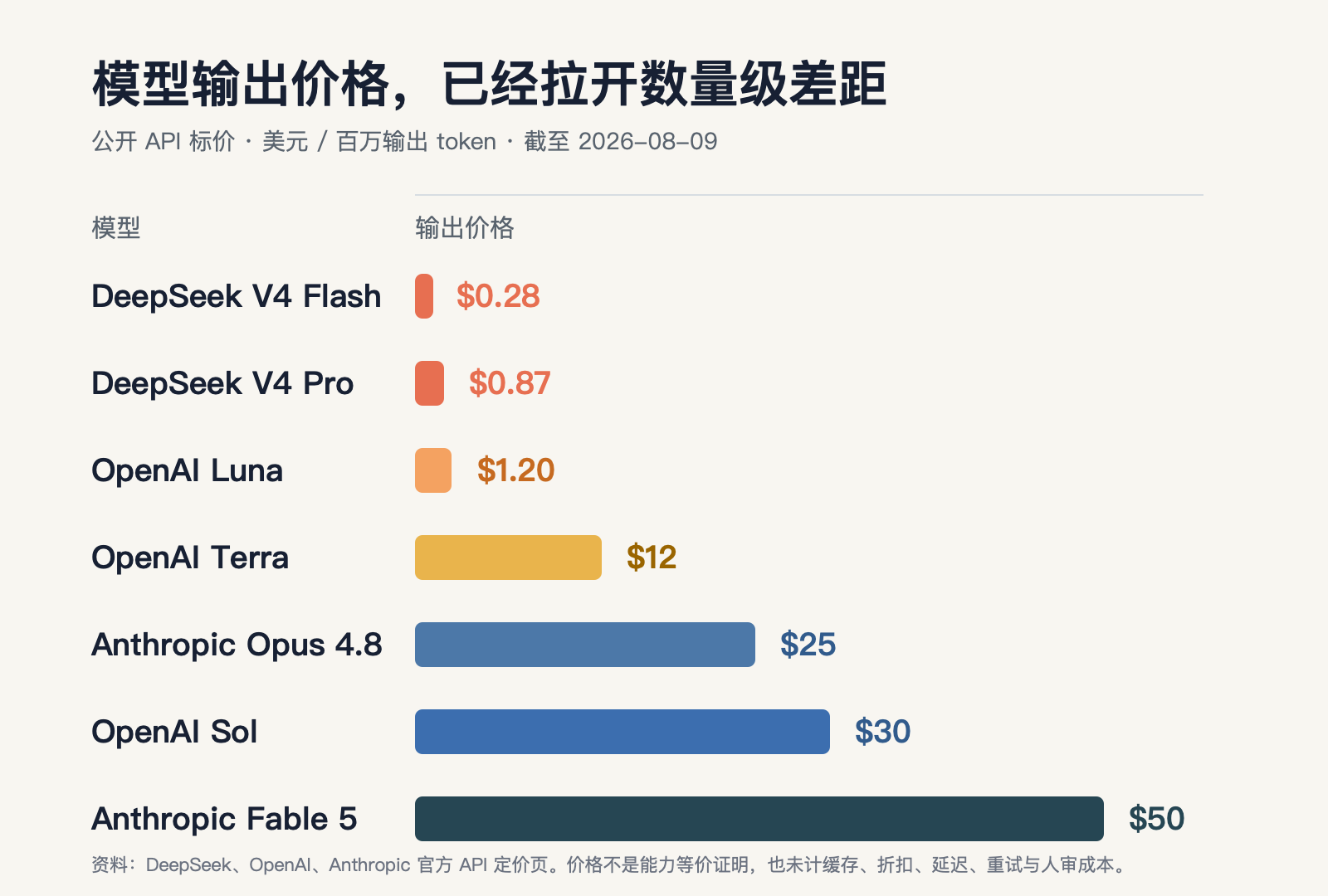
Comparison of mainstream LLM API output prices.
OpenRouter's public data provides an observable calling clue: DeepSeek's share of token traffic on the platform rose from about 9% to about 18%.
About a month after V4 Flash's release, it already accounted for about 70% of DeepSeek's agentic token traffic. OpenRouter also estimates that agentic requests consume about 15 times more tokens per call than regular requests.
This isn't DeepSeek's global call or revenue data, but it's enough to show: the low-cost model isn't just leading to "asking a few more times," but rather more tasks are starting to be handed over to agents for continuous execution.
Therefore, DeepSeek's kill line isn't about being "so cheap it makes closed-source models disappear," but first about pulling down the price anchor for usable models.
What Gets Penetrated First Are Mid-Tier Model Prices
When enterprises deploy AI, fewer and fewer are stuffing the most expensive model into every step.
A more common approach is: complex planning, critical judgment, and final review go to models that are more capable and more expensive.
Decomposed execution, batch processing, retrieval summarization, format conversion go to lower-cost models; if the cheap model can't handle it well, then upgrade.
This is model routing.
Its core isn't about saving a few dollars, but making choices based on the "total cost to complete a task." Token list price is just one component; wait time, retry count, manual review, rework, and stability are often more expensive.
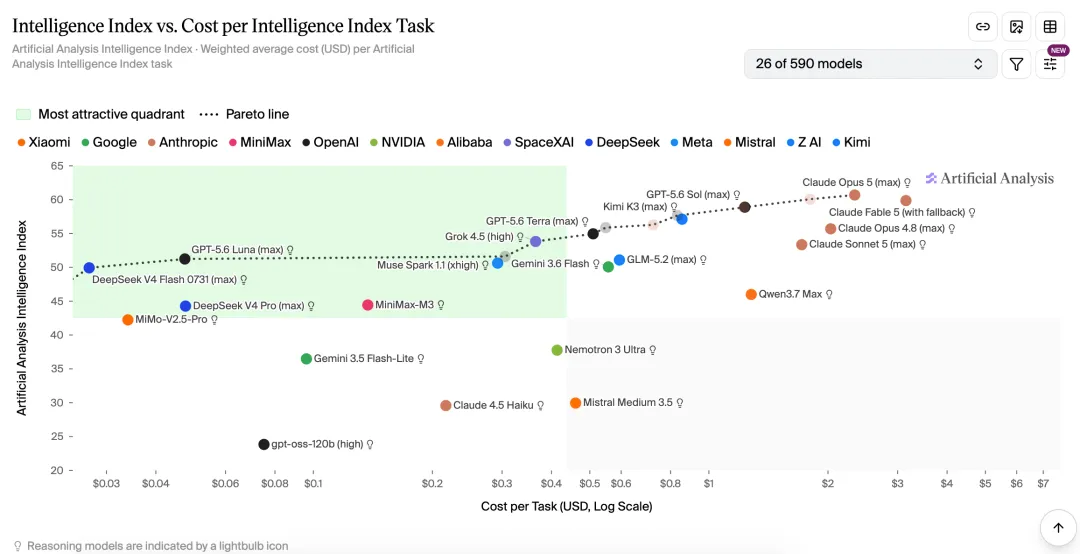
Model competition ultimately comes down to capability versus cost.
Jensen Huang said at a public NVIDIA event that the future isn't "closed-source vs. open-source," but "closed-source and open-source" together forming multi-model systems. Enterprises need different models to handle different data and workflows.
This also explains who the kill line hits first: not the strongest models, but the middle layer—those without significant capability leads, yet much more expensive than cheap models; and without strong enough delivery, industry data, or product entry points to justify the premium.
The most difficult question they'll face from customers becomes very specific: if both can get this job done, why pay so much more?
OpenAI and Anthropic: Short-Term Pain, Long-Term Not Necessarily Losing
A downward shift in the price anchor is certainly not good news for OpenAI and Anthropic in the short term.
Axios reported that OpenAI's Luna dropped its price by about 80% roughly three weeks after launch. This move at least indicates that high-throughput, general-purpose execution models have entered more intense price competition.
But we shouldn't simply write off both companies as "cut down by DeepSeek."
Complex reasoning, long-chain tasks, enterprise-grade reliability, tool ecosystems, and product entry points remain areas customers are willing to pay for. As long as frontier capabilities continue to lead, closed-source models will still occupy that portion of the hardest, most error-intolerant work.
Anthropic doesn't publish an official ARR curve for month-over-month comparison. However, third-party TickerTrends' July tracking estimates show: Anthropic's annualized revenue is still growing, but the increase from June to July was smaller than the steep climbs in previous months.
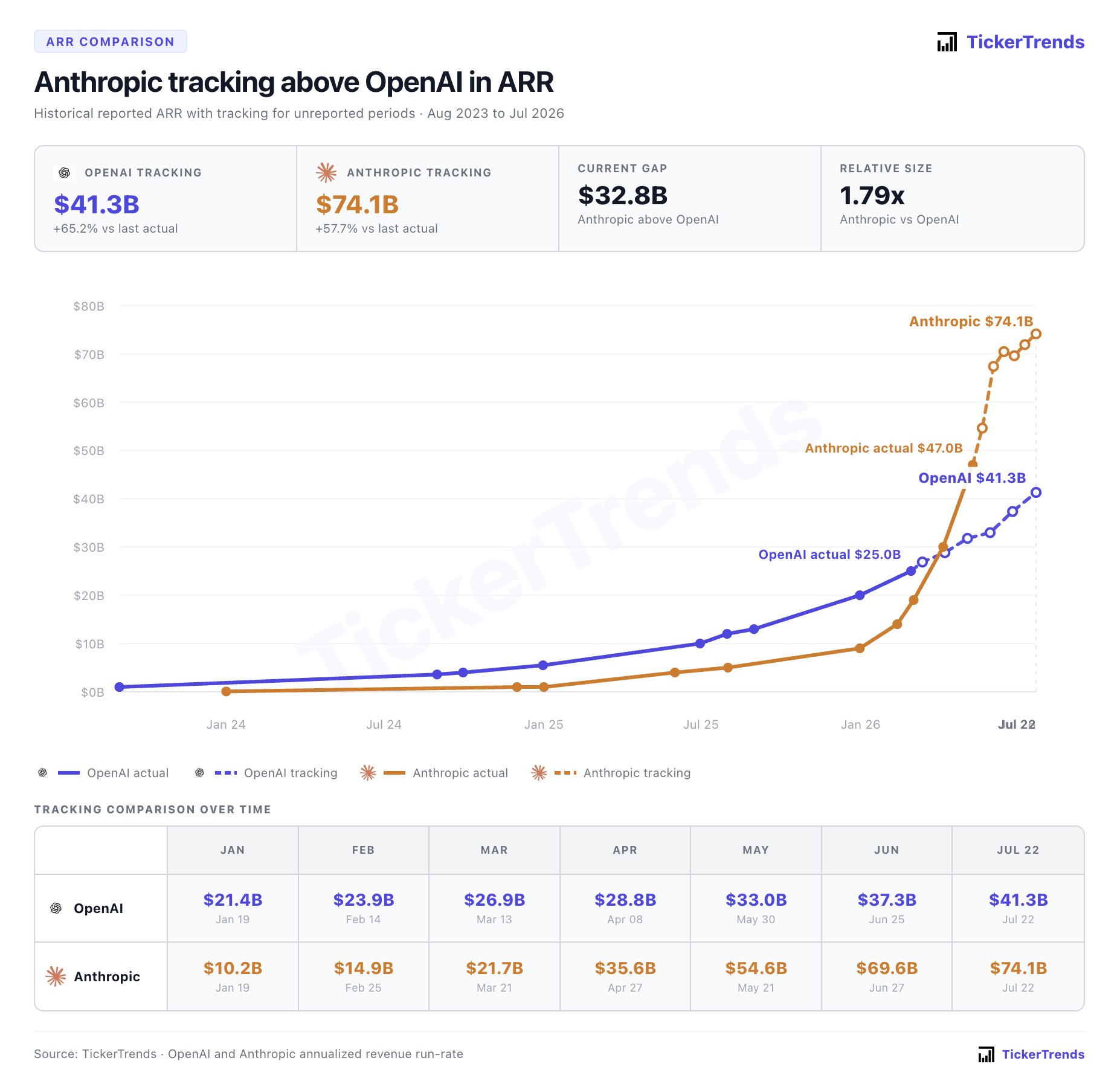
Third-party tracking: Anthropic's growth is still fast, but marginal increments are starting to slow.
What the chart really illustrates isn't that Anthropic is "done for," but rather: even as the revenue base continues to grow, the market is shifting its focus from "who's growing faster" to "whether this growth can be sustained at lower unit prices."
What will truly change is the past imagination in the model layer that "as long as you're the strongest, you can maintain super-high premiums long-term." Prices will be lower, usage will be greater, and the profit pool will be redistributed towards frontier capabilities, product entry points, enterprise delivery, and model routing.
For OpenAI and Anthropic, this is an uncomfortable transition period; but as long as the pie continues to grow, they aren't necessarily losers, they just likely can't rely solely on model scarcity to take the fattest profits anymore.
Open Source Isn't Free: DeepSeek Is Also Doing the Math
Another common question is: if the models are open source, how does DeepSeek make money?
Liang Wenfeng gave a very representative answer in a summary of a non-public exchange. He summarized the long-term differences in LLMs as cost, time, and user experience; with cost ranked first.
Cost here isn't just "how many GPUs were bought" or "the list price per token." More crucially, it's whether one can integrate model architecture, operators, compilation, caching, scheduling, and hardware adaptation to achieve lower delivery costs.
According to that summary, DeepSeek is advancing high-level languages and operator tools like TileLang and participating in Ascend ecosystem adaptation.
The public TileLang-Ascend project already supports high-performance operator development for Ascend NPUs and lists DeepSeek V4 kernel support.
This doesn't mean external parties have verified DeepSeek's actual unit cost or the extent of its cost advantage.
It at least explains why Liang Wenfeng puts "cost" first: with the same model weights, different deployment efficiencies can lead to completely different final service costs when sold.
According to that summary's record, DeepSeek's pricing rationale is: after buying a batch of equipment, recouping the equipment cost in about ten months is considered reasonable profit.
This rationale isn't DeepSeek's audited financial data, but it well illustrates a mindset: not setting API prices at the profit-maximizing point, but at a point that's "low enough to spread quickly, while still allowing cost recovery."
Open-source weights can be downloaded, but running models at scale, stably, doesn't happen automatically. GPUs, data center power, cluster scheduling, caching, operations, and enterprise SLAs all reappear on the cost sheet.
If a company's deployment efficiency and service capability are strong enough, it's entirely possible to open the model while making money from hosted inference, delivery capabilities, and ecosystem diffusion.
Open source doesn't necessarily hurt a model company's profitability; it hurts business models that only want to hoard weights and collect high rents long-term.
This is also where DeepSeek is most worth peers' serious attention: it's not proving "open source is always more profitable," but proving that low cost, open diffusion, and reasonable profit can coexist.
No Winners or Losers in the Short-to-Medium Term, Only Different Paths
When Futu Niu Niu relayed a Morgan Stanley analysis, it broke down the future of the model industry into three scenarios: closed-source models continue to lead; closed-source and open models coexist long-term; open models become mainstream.
In the latter two scenarios, value will flow more towards hosting, deployment, enterprise software, and distribution channels.
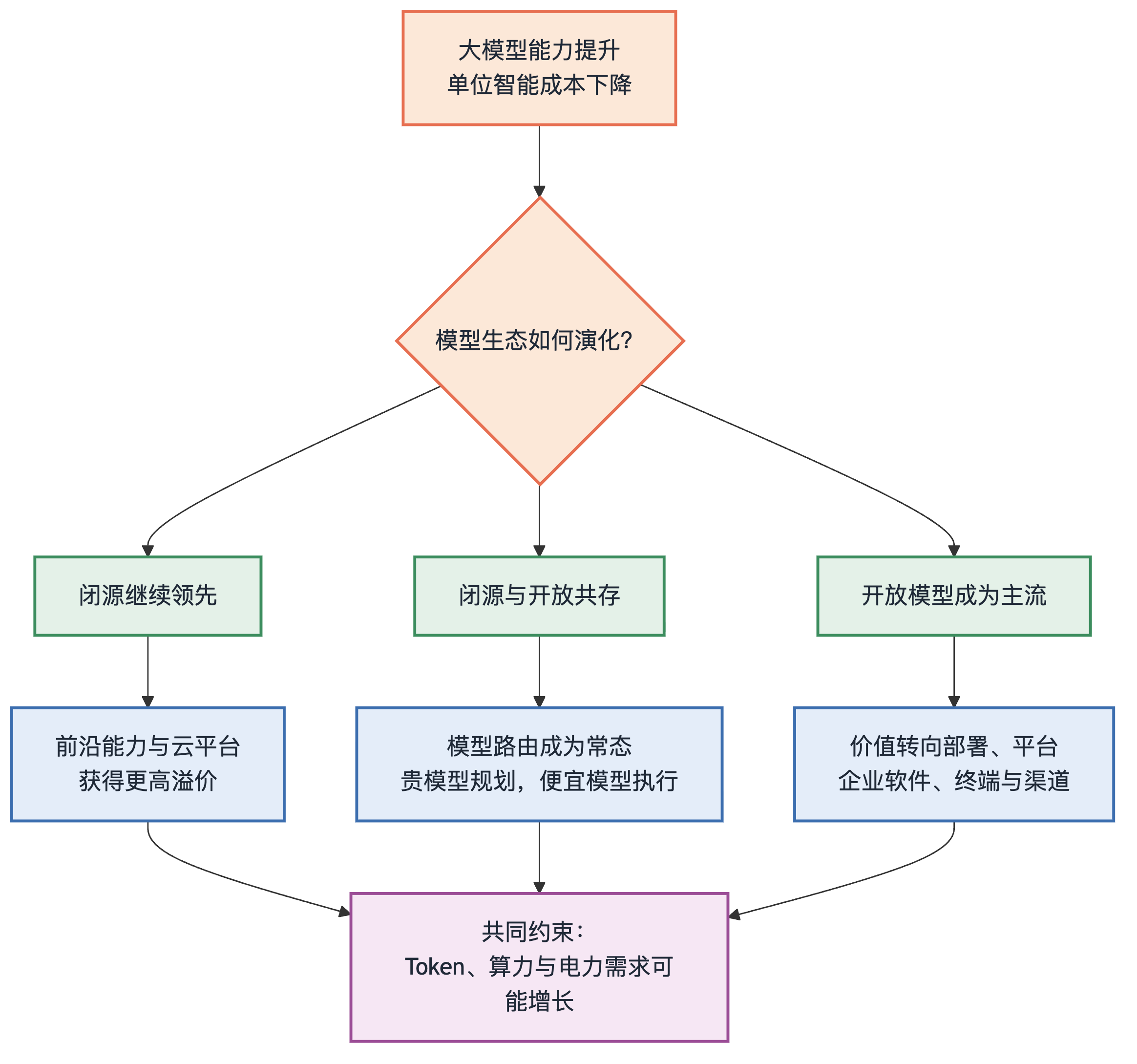
Closed-source leads, hybrid coexistence, open-source mainstream.
However, my judgment is: in the short to medium term, until China resolves the semiconductor process bottlenecks, US closed-source models will likely remain ahead on the most difficult tasks.
The US possesses more concentrated cutting-edge computing power, capital, talent, and cloud platforms. These advantages won't disappear just because a low-priced model emerges.
On the other hand, the capabilities and costs of Chinese open-source models are rapidly catching up. The release of Kimi K3 is a signal: its paper still considers the strongest closed-source models as benchmarks, but open models are already entering the competitive range on more specific tasks.
Open-source models are also difficult to simply "block" from markets outside the US. Model weights can be downloaded, fine-tuned, and deployed locally; the ecosystem itself is globally fluid.
Jensen Huang recently stated publicly: "The world needs open models."
Therefore, what's more likely in the short to medium term is stratification and coexistence: closed-source continues to push the limits of capability, while open-source keeps chasing and brings intelligence to more scenarios that previously couldn't afford it or the computing power.
What Gets Repriced in the End, Is Still People
Back to the title: Who does the LLM "kill line" ultimately kill?
In the model market, it first kills the unreasonably high prices of mid-tier models.
Within organizations, it's more likely to kill chunks of white-collar work hours that can be decomposed, standardized, reviewed, and executed in batches.
Filling forms, researching information, revising drafts, creating summaries, writing template code, standardized customer service, and the vast amount of execution work of passing a task to the next person will all be repriced first.
This doesn't mean "all white-collar workers will be replaced." Complex judgment, responsibility-taking, relationship coordination, and being accountable for outcomes are still not things that automatically get solved just by making tokens cheaper.
But the continuous decline in the unit cost of intelligence will make more companies seriously calculate: Why should this task still be done repeatedly by a person? When more and more teams write this question into their budget sheets, AI adoption will truly accelerate.
So, the LLM kill line was never the death line for any particular model company.
It's a line of popularization: on one end, it pushes down model prices; on the other, it raises the feasibility of automation.
For hardware, cloud, and applications, it may bring more calls, more deployments, and more demand; for cutting-edge model companies, it forces them to make their capabilities stronger and their services deeper.
But for workers performing standardized, execution-type work, it brings the most direct and brutal repricing.
References
- DeepSeek API Pricing Page (Official) — Official source for V4 Flash pricing and peak/off-peak pricing rules, origin of price data in this article
- SCMP: DeepSeek Peak Hour API Surcharge Report — Report on peak-hour surcharge arrangements and their background
- OpenRouter: DeepSeek V4 Adoption Insights — Source for the token share and agentic traffic data cited in this article
- TickerTrends: Anthropic vs OpenAI ARR Tracking — Third-party tracking estimates of annualized revenue growth for the two companies
- NVIDIA Official Blog: The Future of AI Is Open and Proprietary — Source for Jensen Huang's views on the coexistence of open and proprietary models
Scan with WeChat to share
Screenshot or long-press the QR code to forward it
📌 Related Posts
RSI: When AI Learns to Improve Itself, Do the Strong Really Get Stronger?
RSI is 2026's most-watched tech race: Anthropic data, OpenAI timelines, open-source moves — but is the 'strong get stronger' narrative truly irreversible?
Looking Back at the 2000 Dot-Com Bubble: Where Is AI Now?
July 2026 saw AI trading turn risk-averse, sinking chips, memory, and software stocks as the Nasdaq 100 fell 9.5% from its high.
Leopold Aschenbrenner: AI, Electricity, and the Trillion-Dollar Cluster
Situational Awareness Fund sells most of its public equity portfolio to Citadel, surrendering a successful AI trade amid market reversal.
Subscribe to Updates
Leave your email to get the latest articles and project updates — or subscribe with your favorite RSS reader
Add 0to1.site/en/rss.xml to RSS readers like Feedly or Inoreader
Comments (no account needed, anonymous welcome)
No comments yet — be the first!