The Real Opportunity in the AI Era Lies in the B2B Sector
Notice how the "AI bubble" debate has vanished? OpenAI and Anthropic's real ARR revenue proves AI is a profitable business.
1. AI Is No Longer a Concept; It's a Tangible Business
Have you noticed that almost no one outside the industry is discussing "whether AI is a bubble" anymore?
That's because companies like OpenAI and Anthropic have convinced everyone with solid, tangible ARR revenue—AI isn't just PowerPoint slides; it's a genuine, money-making business.
What's even more noteworthy is the emergence of AI Coding. This makes AI not just a tool, but a gateway that can create its own tools. It can transform workflows in any industry, and this "superpower" means its application boundaries are virtually limitless.
So, where is the biggest entrepreneurial opportunity of this era?
I'm increasingly convinced: It's in the B2B sector.
2. Why Is the Consumer Side So Difficult?
It's not that there are no opportunities on the consumer side, but the reality is harsh.
For the average user, AI is more of an "efficiency tool." Super-individuals are indeed using it, but most people face three major barriers:
- Psychological Level: Fear of being replaced by AI, leading to instinctive rejection or even resistance.
- Willingness to Pay: Even if they use it, the willingness to pay is extremely low, with "free and good enough" being the common expectation.
- Customer Acquisition: High promotion costs, long user education cycles, and poor conversion rates.
The logic of the consumer side is "first capture the audience, then figure out how to monetize." This path requires massive capital investment and long time cycles—it's not a battle ordinary entrepreneurs can fight.
3. The B2B Side Is Completely Different: AI Here Equals Productivity
The mindset of B2B business owners is entirely different from that of consumer users.
They aren't hesitating about "whether to use AI"; they're anxious about "how to use it," "which one to use," and "whether their competitors are already using it."
The reason is simple: In the B2B context, AI directly equals cost reduction and efficiency gains, which translates to real money.
Businesses calculate very rationally—if AI can replace the work of three salespeople, the saved labor costs become real profit. As long as the money paid to an AI service provider is less than the saved labor costs, the deal is worth it. For business owners, there's almost no debate about this logic.
4. A First-Hand Case: Building an AI Agent for a Foreign Trade Company
Recently, I helped a foreign trade company customize a set of AI Agents. The complete process is as follows:
① Automatically Obtain Sales Leads Actively searches for potential buyer information based on target markets and customer profiles.
② Customized Outreach Emails Generates personalized outreach emails based on customer background and industry characteristics, rather than using mass email templates.
③ Automated Follow-up and Replies When customers respond, the AI automatically answers questions, advances communication, and assesses interest level.
④ Precise Distribution to Sales Only when a customer shows clear purchase intent is the lead distributed to a human salesperson for follow-up, avoiding wasted sales effort.
What was the result? The foreign trade business owner was thrilled.
The biggest cost for a foreign trade company is its salespeople—and tasks like "proactively developing clients," which are highly repetitive and have low conversion rates, previously had to be done by throwing people at the problem. Now, handing this over to the Agent allows human energy to be fully focused on "advancing deals" and "maintaining relationships," which is what humans are truly good at.
This company immediately stated: They are willing to pay 50% of the costs saved for this AI transformation.
This is B2B logic—they aren't just "trying something new"; they are genuinely calculating ROI.
5. Let the Data Speak: B2B AI Penetration is Extremely Low, a Vast Blue Ocean
This isn't just my feeling. In March 2026, Anthropic released a heavyweight research report: "Labor market impacts of AI: A new measure and early evidence," which uses large-scale data to quantify the gap between AI's theoretical capabilities and its actual implementation.
The report proposes a core comparison: Theoretical AI Coverage vs. Actually Observed AI Coverage.
Look at the chart below (from the official Anthropic report):
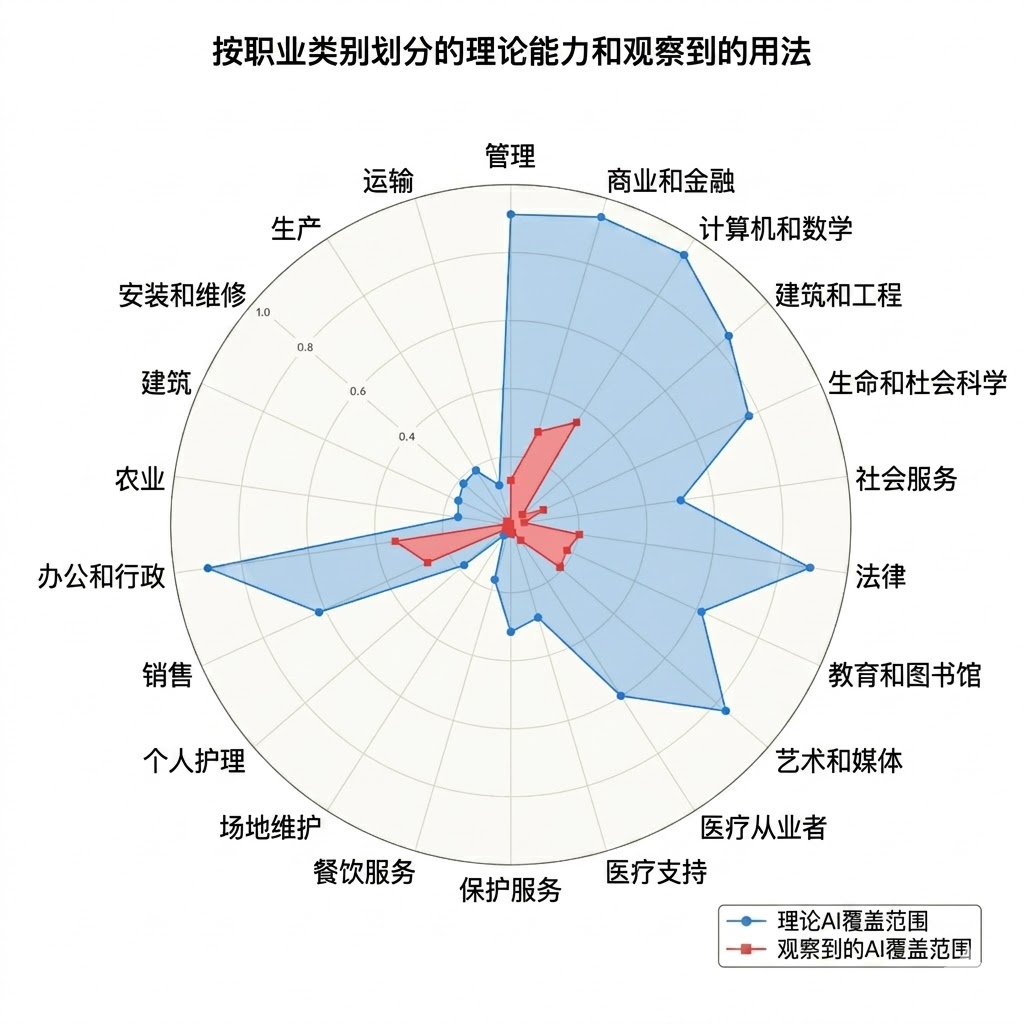
This is a radar chart:
- Blue Area: The range of work tasks AI can theoretically cover.
- Red Area: The range where AI is actually being used in enterprises.
That huge blank space between the blue and red areas is the market not yet penetrated by AI.
Specific data:
| Occupational Category | Theoretical AI Coverage | Actual AI Coverage | Penetration Gap |
|---|---|---|---|
| Computer/Mathematical | 94% | 33% | 61 percentage points |
| Management | High | Extremely Low | Huge |
| Business/Financial | High | 28.4% | Huge |
| Office/Administrative | 90% | Far below theoretical | Huge |
| Legal | High | Extremely Low | Huge |
The report's conclusion is very direct:
"AI is far from reaching its theoretical capability: actual coverage remains a fraction of what's feasible."
In other words: For computer-related work, AI can theoretically replace 94% of tasks, but actual implementation is only at 33%—over 60% of the space remains untapped.
Another noteworthy data point: Globally, 30% of the working population still has zero AI coverage (physical labor positions like chefs, maintenance workers, waiters, etc.). AI's current main battlefield is knowledge work within enterprises—and this is precisely the core of the B2B sector.
6. Who's Most Anxious? Highly Educated, High-Salary White-Collar Workers
The report reveals a counterintuitive phenomenon: Positions with higher education levels and higher salaries face the greatest pressure from AI substitution.
Profile of workers in high-AI-exposure occupations:
- Average salary is 47% higher than in low-exposure occupations.
- The proportion with postgraduate degrees is 4 times that of low-exposure occupations (17.4% vs. 4.5%).
The report also provides a ranking of the most affected specific occupations:
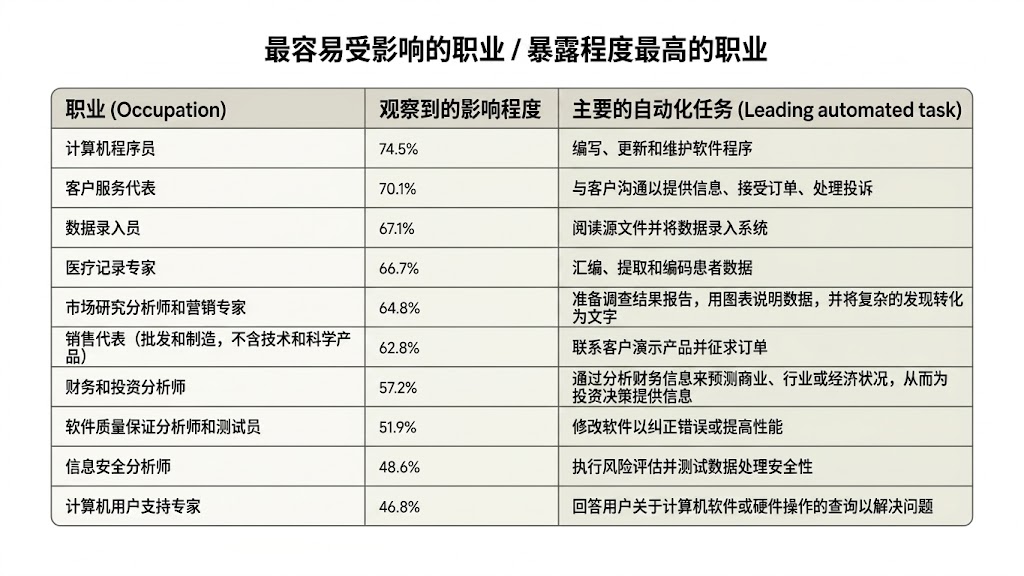
The top-ranked positions are almost all core B2B roles:
- Computer Programmers: 74.5% exposure. Coding and maintenance tasks are being heavily taken over by AI.
- Customer Service Representatives: 70.1% exposure. Information responses and complaint handling are highly automatable.
- Data Entry Keyers: 67.1% exposure. Typical repetitive transactional work.
- Market Research Analysts: 64.8% exposure. Data organization and report writing are AI's strengths.
- Sales Representatives (Wholesale/Manufacturing): 62.8% exposure. Contacting customers, product demonstrations, soliciting orders.
- Financial and Investment Analysts: 57.2% exposure. Information analysis and predictive modeling.
Pay attention to Sales Representatives—62.8% exposure. This precisely confirms the data from my earlier foreign trade case: tasks like "proactively developing clients, sending outreach emails, follow-up replies" done by foreign trade salespeople are exactly the kind of batch-processable tasks AI excels at. This isn't an isolated case; it's a widespread phenomenon across the industry.
Early signals are already appearing in the labor market: The hiring rate for new graduates aged 22-25 in high-AI-exposure positions has dropped by 14% since ChatGPT's release.
Businesses aren't conducting large-scale layoffs; they are quietly closing the door on hiring new people—using AI to fill manpower gaps instead of continuing to hire.
7. Now is the Right Time to Enter
Anthropic's report also shows that currently, in the enterprise context, 52% of AI use is for augmentation (humans using AI to improve efficiency), and 45% is for automation (AI directly completing tasks).
This indicates: Most B2B scenarios are still in the "human + AI" collaboration stage; true automated replacement has only just begun.
The large-scale implementation of AI in the B2B sector is still at a very, very early stage.
That huge blank space between the blue and red areas on the radar chart is the market that will be gradually filled in the coming years. Whoever enters first, whoever establishes service capabilities and industry expertise first, will capture this wave of opportunity.
The entry logic for the B2B side is also clear:
- Help them save money (replace repetitive labor) → They are willing to pay you a portion of what they save.
- Help them make money (expand business boundaries) → They are even more willing to pay and will proactively seek contract renewals.
There's only one key rule: Deliver tangible value to B2B clients, not just sell concepts.
8. Conclusion: Opportunity Lies in the Gap
If you're also thinking about how to enter the AI field—
Look at the B2B side first. Find an industry you're familiar with, think about which repetitive, inefficient tasks could be replaced by AI, and that's your entry point.
Foreign trade, law, finance, HR, customer service, marketing... In every traditional industry, there are vast amounts of "inefficient work done by humans" waiting to be transformed.
The opportunity lies hidden within that 61-percentage-point gap.
Data Source: Anthropic "Labor market impacts of AI," March 2026 https://www.anthropic.com/research/labor-market-impacts
References
- Anthropic Research Report "Labor market impacts of AI: A new measure and early evidence" — The primary data source for this article, quantifying the significant penetration gap between AI's theoretical capabilities and its actual enterprise adoption
Scan with WeChat to share
Screenshot or long-press the QR code to forward it
📌 Related Posts
Enterprise AI Implementation: It's Not the Tools Being Rebuilt, but the Production System
Enterprise AI's paradox: leaders tout full adoption and demos impress, yet delivery and output barely move — the real gains stay at the individual level.
What B2B AI Implementation Really Needs Isn't Smarter Agents
On May 28, 2026, Anthropic launched Dynamic Workflows for Claude Code, a feature that is now officially available.
Anthropic Founder's Handbook
Anthropic's 35-page startup guide reveals AI now eliminates three major barriers: funding, talent, and technical skills.
Subscribe to Updates
Leave your email to get the latest articles and project updates — or subscribe with your favorite RSS reader
Add 0to1.site/en/rss.xml to RSS readers like Feedly or Inoreader
Comments (no account needed, anonymous welcome)
No comments yet — be the first!