What B2B AI Implementation Really Needs Isn't Smarter Agents
On May 28, 2026, Anthropic launched Dynamic Workflows for Claude Code, a feature that is now officially available.
On May 28, 2026, Anthropic rolled out a very interesting feature for Claude Code: Dynamic Workflows. Initially released as a research preview, the official page has now been updated to indicate it's generally available.
We've often liked to pit Agent and Workflow against each other:
- Agents think and adapt on the fly, but they're not very stable.
- Workflows execute along fixed paths. They're not very smart, but they're highly controllable.
But Claude Code's new approach is starting to blur this line.
You just need to give it a sufficiently large task, and Claude can temporarily generate a set of orchestration scripts. It splits the work among dozens or even hundreds of sub-agents for parallel processing, arranges for other agents to cross-check, and finally consolidates everything into a single result.
Anthropic gave an extreme example: Bun founder Jarred Sumner used dynamic workflows to migrate approximately 750,000 lines of code from Zig to Rust. The process took 11 days from the first commit to merge, with a 99.8% pass rate on existing tests. Of course, Anthropic also specifically noted that this version was not yet in production at the time.
What's truly noteworthy about this case isn't just "how much more code AI can write."
More importantly, it illustrates one thing:
Agents and Workflows might not be two mutually exclusive technical paths. The more common form in the future will likely be Agents handling uncertainty, while Workflows constrain that uncertainty.
This is also a feeling that's been growing stronger for me lately: when discussing B2B AI implementation, if we're still stuck on "should we use an Agent or a workflow?", we might be asking the wrong question.
Enterprises have never really cared about technical jargon; what they care about are these things:
- If something goes wrong, can we detect it promptly?
- Why was this decision made? Can we trace it back?
- Can we pause execution midway?
- Can we get human confirmation before critical actions occur?
- If we change the model, prompt, or business rules, will the results suddenly drift?
- If an accident really happens, who bears the loss?
Ultimately, what the B2B sector needs isn't an Agent that just looks smart, but a production system for using intelligence in a controlled manner.
The Problem with Agents Isn't That They're Not Smart Enough
The most valuable aspect of an Agent is precisely that it doesn't follow a preset path rigidly.
It can search for information on its own, choose tools, modify plans, and adjust its next steps based on execution results. This capability is incredibly useful for tasks with vague requirements, incomplete information, or paths that can't be hardcoded in advance.
For example:
- Reading an unfamiliar codebase and locating a bug.
- Researching ten competitors and summarizing their product differences.
- Generating a customized outreach email based on a client's website, past communication, and product library.
- Finding anomalous clauses in a pile of poorly formatted contracts.
The common thread in these tasks is: You know what result you want, but it's hard to specify exactly how to do each step in advance.
And that's also where the problem lies.
An Agent's path isn't completely predetermined. Executing the same task twice, it might search different sources, call different tools, and ultimately provide different answers.
If it's just helping an engineer debug, being wrong might mean starting over. But if it's directly sending emails to ten thousand customers, modifying product prices, approving refunds, or processing payments, the risk is on a completely different scale.
Therefore, the real dividing line isn't "can this task be given to an Agent?", but rather:
How much error probability is acceptable in this step? And if an error occurs, is the loss reversible?
What Enterprises Pursue Isn't Just "De-manning"
Many people say the core demand for enterprises adopting AI is "de-manning."
This statement is partly correct, but it's too easy to oversimplify the issue.
Enterprises certainly want to reduce repetitive labor, but what they ultimately pay for usually isn't "fewer people," but rather:
- Can the same people handle more business?
- Can delivery time be shortened from three days to three hours?
- Can the error rate be reduced?
- Can new employees get up to speed faster?
- Can the process be replicated across more departments and regions?
- Can managers see what's happening at every step?
If an AI system saves two people but requires three others to monitor it daily, put out fires, and verify results, that's not automation—it's just a different form of overtime.
Therefore, what B2B truly wants to buy is stable business outcomes, not an impressive model demo.
The Value of Workflows is Putting Guardrails on Intelligence
The advantages of traditional workflows are straightforward: clear steps, defined inputs/outputs, retryable failures, and easily traceable responsibility.
But workflows aren't inherently reliable either.
As soon as a large model node is added, the system still contains probability. Even the most neatly designed n8n flow can't guarantee the model will make the same judgment every time.
Thus, a more realistic architecture isn't "all Agent" or "all workflow," but rather splitting a business process into segments with different risk levels:
-
Deterministic steps go to code.
Querying databases, validating fields, calculating amounts, judging permissions—anything that can be written as explicit rules shouldn't be left for the model to guess. -
Fuzzy judgments go to Agents.
Information retrieval, content understanding, intent recognition, solution generation—these are the steps that can't be fully hardcoded. Let the model use its capabilities here. -
High-risk actions require approval.
For actions like sending emails, making payments, issuing refunds, deleting data, or modifying live configurations, add human confirmation or stricter automated checks before execution. -
Log all key processes.
What data was used, what tools were called, what reasoning the model provided, who approved the final action—all of this should be traceable. -
Make failures rollback-able.
Enterprise systems shouldn't only design for the "success path." They must also plan in advance for how to recover from timeouts, model exceptions, API failures, and erroneous executions.
At this point, a Workflow is no longer just a drag-and-drop flowchart. It becomes a set of mechanisms for permissions, state, logging, evaluation, and exception handling.
What Changes Does Claude Code's Dynamic Workflow Bring?
The interesting thing about Claude Code's Dynamic Workflows is: The workflow itself can also be dynamically generated by an Agent.
Traditional workflows are usually drawn up in advance by a person:
Step 1: Do A. If successful, do B. If failed, go to C.
Dynamic workflows are more like a temporarily assembled project team:
First, understand the goal, then break down tasks. Parallelize what can be parallelized. Let different Agents solve problems independently. Then arrange for Agents to check and rebut. If conclusions don't align, iterate further.
It's suitable for tasks like codebase-level bug investigation, large-scale migrations, security audits, and performance optimization—tasks that are difficult to accomplish with a single fixed chain. If a task is interrupted, it can resume from the existing progress, not from scratch.
But this doesn't mean enterprises can finally hand over their production systems entirely to Agents.
On the contrary, the stronger the dynamic workflow, the more important governance becomes.
Hundreds of Agents working in parallel means higher token consumption, more tool calls, more complex permission boundaries, and a larger radius for error propagation. Anthropic also explicitly warns that dynamic workflows consume far more resources than regular Claude Code sessions. The first time it's triggered, it will show the content about to run and require user confirmation. Enterprise administrators can also disable this capability.
So it's more like telling us:
The capability ceiling of Agents is rapidly rising, but the stronger they become, the more they need to be placed within an observable, confirmable, and interruptible execution framework.
How Should We Choose Among Common Technical Paths?
Let's first use a table to clarify the positioning of several paths:
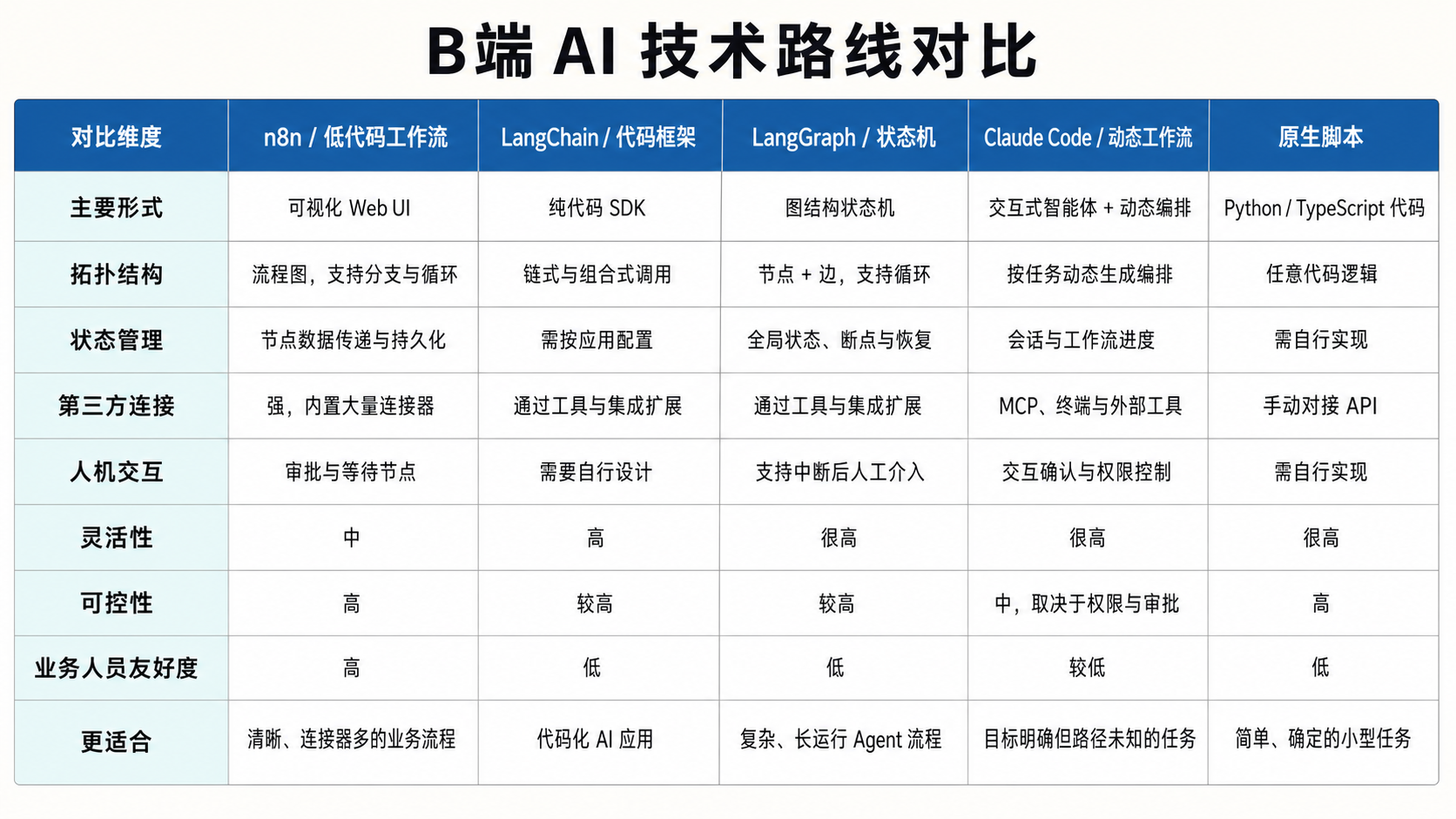
| Comparison Dimension | n8n / Low-Code Workflow | LangChain / Code Framework | LangGraph / State Machine | Claude Code / Dynamic Workflow | Native Script |
|---|---|---|---|---|---|
| Primary Form | Visual Web UI | Pure Code SDK | Graph-Based State Machine | Interactive Agent + Dynamic Orchestration | Python / TypeScript Code |
| Topology | Flowchart, supports branches & loops | Chained & composed calls | Nodes + Edges, supports loops | Task-dynamically generated orchestration | Arbitrary code logic |
| State Management | Node data passing & persistence | Requires application-level configuration | Global state, checkpoints & recovery | Session & workflow progress | Must be implemented manually |
| Third-Party Connectivity | Strong, many built-in connectors | Extended via tools & integrations | Extended via tools & integrations | MCP, terminal & external tools | Manual API integration |
| Human-in-the-Loop | Approval & wait nodes | Requires custom design | Supports human intervention after interruption | Interactive confirmation & permission control | Must be implemented manually |
| Flexibility | Medium | High | Very High | Very High | Very High |
| Controllability | High | Relatively High | Relatively High | Medium, depends on permissions & approvals | High |
| Business User Friendliness | High | Low | Low | Relatively Low | Low |
| Better Suited For | Clear processes with many connectors | Coded AI applications | Complex, long-running Agent workflows | Tasks with clear goals but unknown paths | Simple, deterministic small tasks |
This table is not a tool ranking, but rather helps us first determine which category a business problem belongs to.
1. Visual Low-Code Platforms: Get the Business Running First
Representative products include n8n, Dify, Coze, Zapier, Make, Activepieces, etc.
They are suitable for scenarios with relatively clear processes, many SaaS connections, and requiring business personnel to participate in configuration, such as lead synchronization, content moderation, customer service routing, form processing, and internal notifications.
The advantages are quick onboarding, intuitive workflows, and rich connectors; the issue is that as complex logic increases, flowcharts can also become difficult to maintain. Multi-person collaboration, version management, and multi-environment deployment are often less natural than with pure code.
2. Coded Orchestration Frameworks: Incorporate Complexity into the Engineering System
Representative solutions include LangGraph, various Agent SDKs, and state machines and task systems built in-house by teams.
They are suitable for scenarios involving complex branching, long-running tasks, parallel tasks, checkpoint recovery, fine-grained permission control, etc.
The advantage is integration into Git, testing, Code Review, and CI/CD systems; the cost is a higher development barrier, and modifications to business rules typically still rely on the engineering team.
3. Interactive Agents like Claude Code: Handling Open-Ended Tasks
This type of tool excels at tasks that are "goal-oriented but path-unknown." It can read context, call terminals and external tools, and continuously adjust plans based on results.
Dynamic Workflows further push it from "one Agent working continuously" towards "temporarily generating a multi-Agent orchestration."
It is well-suited for R&D, research, analysis, and complex project execution. However, whether it can enter core production pipelines still depends on permission isolation, approvals, logging, testing, and rollback mechanisms, not on how smart the model appears.
4. Native Scripts: Don't Over-Engineer Simple Scenarios
If a task is simply pulling data once a day, calling a model for classification, and writing results to a spreadsheet, a clear Python or TypeScript script might already suffice.
Pure scripts are not inherently outdated. The real problem is when tasks start involving queues, retries, state recovery, manual approvals, and multiple external systems. Continuing to cram all logic into a single script will cause maintenance costs to rise rapidly.
The Technology Selection Table Actually Worth Making
Instead of comparing which framework is "most advanced," it's better to first answer these questions:
| Business Question | What to Focus On More |
|---|---|
| Can the process be clearly defined in advance? | Fixed workflow vs. dynamic planning |
| How costly is a single mistake? | Automatic execution, machine verification, or manual approval |
| Can results be objectively verified? | Rule validation, test sets, evaluation models, or sampling checks |
| Does the task need to run for hours or even days? | State persistence, checkpoint resumption, and task queues |
| Will it write to core business systems? | Least privilege, sandboxing, approvals, and rollback |
| Do business rules change frequently? | Low-code configuration vs. code-based management |
| Does the data contain sensitive information? | Data classification, anonymization, access control, and compliant deployment |
| Is the operational cost acceptable? | Tokens, concurrency, call counts, and manual verification costs |
Frameworks are merely implementation tools. What truly determines whether a system can go live is whether these questions have been seriously addressed.
B2B AI Implementation Ultimately Competes on System Capability
I am increasingly skeptical of the "one universal Agent to rule all business processes" narrative.
But I also don't believe the future relies solely on humans pre-defining every single workflow.
A more likely emerging form is:
- Humans define goals, boundaries, and responsibilities;
- Agents handle the ambiguous, open-ended, and reasoning-intensive parts;
- Workflows manage state, permissions, and execution order;
- Code handles deterministic rules that cannot fail;
- Humans provide final confirmation at high-risk nodes;
- Evaluation systems continuously monitor for performance drift.
Claude Code's dynamic workflows happen to bring this trend to the forefront: Agents are learning to create Workflows, and Workflows are becoming more dynamic and intelligent.
Therefore, what B2B AI truly needs is neither a singular pursuit of stronger Agents nor a return to rigid process automation.
It needs a new kind of engineering capability:
Encapsulating uncertain intelligence within defined boundaries of responsibility.
Models will continue to evolve, and tools will certainly keep changing.
But as long as a system can achieve task decomposability, process observability, risk controllability, result verifiability, and failure recoverability, it truly earns the qualification to enter the core business of an enterprise.
References
- Anthropic, May 28, 2026: Introducing dynamic workflows in Claude Code
- Anthropic, May 28, 2026: Introducing Claude Opus 4.8
- Claude Code Documentation: Automate workflows with hooks
- Claude Code Documentation: Create custom subagents
- Claude Code Documentation: Claude Code GitHub Actions
Scan with WeChat to share
Screenshot or long-press the QR code to forward it
📌 Related Posts
Anthropic's Agent Decision Checklist: 4 Questions to Determine If You Should Build an Agent
A leaked May 2026 Anthropic deck packs a gem: the 'Should I build an agent' checklist — one chart that can save 90% of AI founders half a year of detours.
The Symbiotic Future of General AI Agents and Agentic Workflows: Exploring the "Workflow + LLM/Agent" Hybrid Model
AI agents and workflows are revolutionizing automation across all industries.
Recent Viral Combo! Three Steps to Integrate Kimi K2 into Claude Code, Get Started Now!
Kimi K2 launches a 1T parameter MoE model with ultra-low pricing (16 yuan per million tokens), seamlessly compatible with the Claude Code coding assistant.
Subscribe to Updates
Leave your email to get the latest articles and project updates — or subscribe with your favorite RSS reader
Add 0to1.site/en/rss.xml to RSS readers like Feedly or Inoreader
Comments (no account needed, anonymous welcome)
No comments yet — be the first!