Deploying LLMs on Consumer GPUs: Token Freedom for Ordinary People?
DeepSeek hiked prices 350% as Qwen3.8-27B went open-source. We test quantizing it on a single 3090, achieve 2.28× speedup, and advise who should dive in.
Opening: The Price Hike Shock
At midnight on August 17th, DeepSeek's new pricing officially took effect.
- V4 Pro peak-hour output: 6 yuan → 27 yuan per million tokens, a 350% increase
- Cache-hit input: 0.025 yuan → 0.3 yuan, a 12x increase
- Peak/off-peak pricing: Peak hours 9:00-12:00, 14:00-18:00, idle hours at half price
The former "price butcher" who once made APIs dirt cheap, the "thick-browed, big-eyed" one who "betrayed the AGI revolution," Liang Wenfeng, once revered as "Saint Liang," is now called "Lao Liang" by many and even mockingly nicknamed "Liang Wengu" because the peak-hour prices are simply too expensive to afford.
In the same week, Alibaba open-sourced Qwen3.8-27B.
The global community is obsessively focused on the same question: Can I deploy this model on a consumer-grade GPU at home and achieve token freedom? A community comment resonated widely: "Qwen 3.8 is having a DeepSeek moment."
Part 1: How Powerful is the Model Itself?
This Isn't Just a "Usable" Model
It has 27B parameters, but its performance metrics rival flagship models.
The third-party benchmark Artificial Analysis gives it a score of 52, tying with DeepSeek V4 Flash (284B parameters) and surpassing all mid-sized models in the 40B-150B range. This is the power of test time scaling: achieving stronger performance through longer reasoning chains.
Look at this chart—the x-axis is parameter count (log scale), the y-axis is intelligence score:
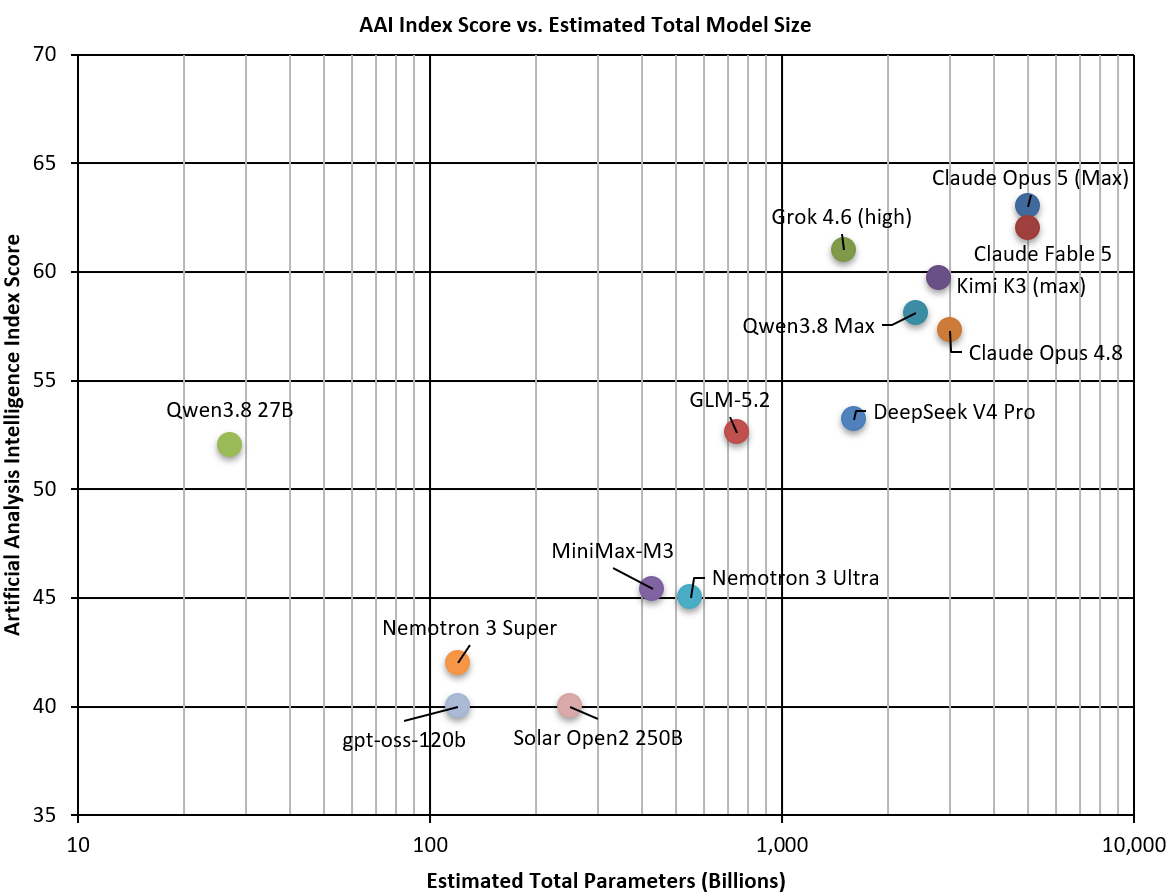
Qwen3.8-27B occupies an anomalous position: achieving flagship-level performance with the smallest parameter count. GLM-5.2, with the same score, has dozens of times more parameters. This is the "sweet spot"—precisely why the community has gone crazy this week.
On Cost Efficiency, It's Still on the Pareto Frontier
But what's truly noteworthy is the dimension of cost efficiency.
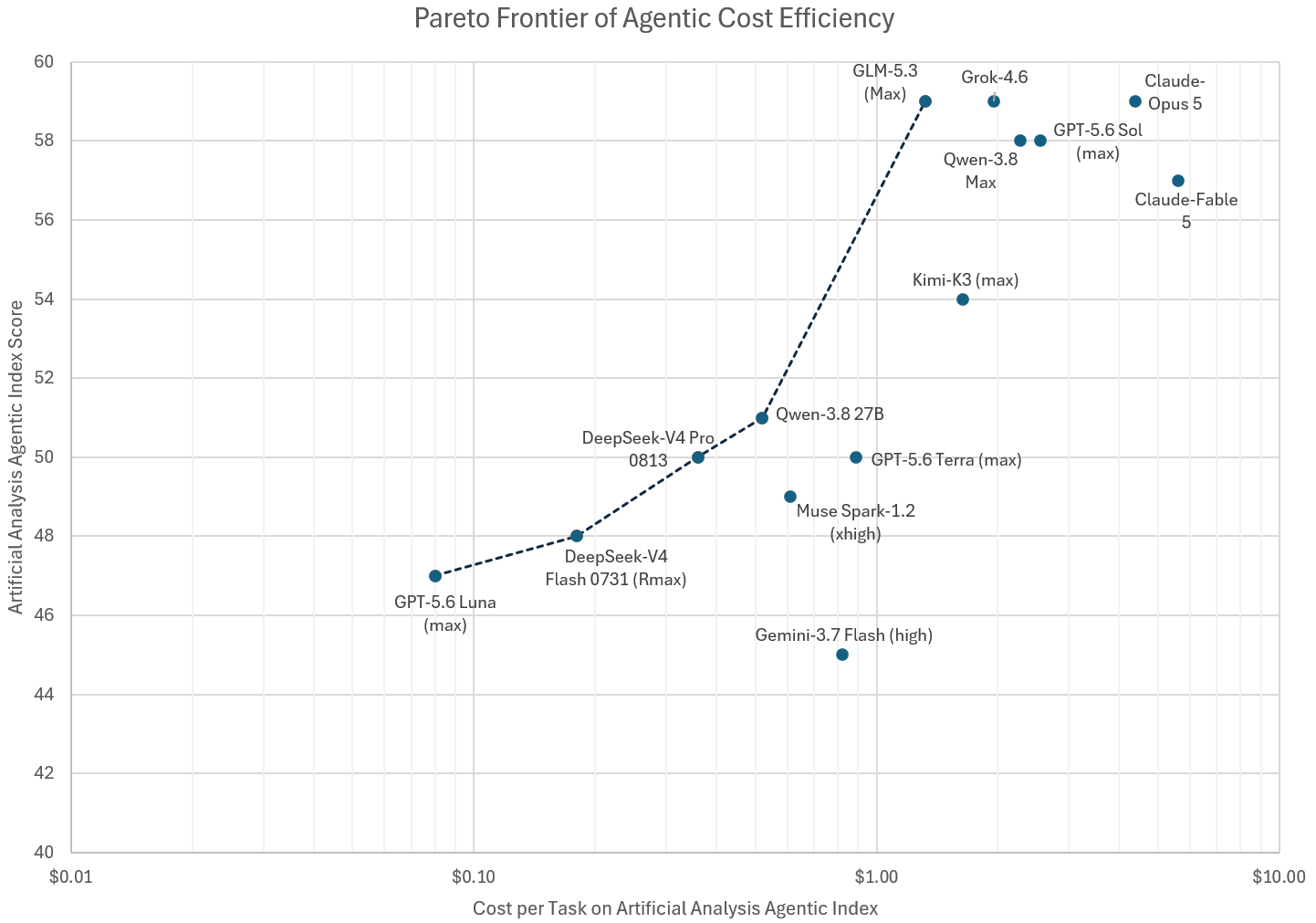
In the recent agent task cost-efficiency benchmark chart released by Artificial Analysis, Qwen3.8-27B sits right on the Pareto frontier—the highest score for a given cost, the lowest cost for a given score. Each task costs about $0.5 for a 51-point score.
For comparison:
- Claude Opus 5: $6/task for 59 points, not on the Pareto line
- Jumping from 27B upwards: GLM-5.3 Max needs $1.5/task to reach 59 points, Grok-4.6 needs $2/task, GPT-5.6 Sol needs $3/task. For each additional point gained, the cost almost doubles.
Here's the key point: By deploying the 27B model locally on a consumer-grade GPU, you're not just getting a "usable" model—you're getting a model on the cost-efficiency Pareto frontier. Together with DeepSeek V4 Flash and V4 Pro, it represents the most efficient line for current AI inference.
Part 2: How to Fit It into a Consumer-Grade GPU
VRAM Solution: From BF16 to W4A16
The community approach (primarily based on the syv-ai repository) is straightforward:
- Take W4A16 quantized weights (community-provided 4-bit weights, 16-bit activations)
- Secondarily quantize lm_head, embed_tokens, and the MTP draft module to int8/int4
- Apply a vLLM patch to keep the model, draft, and KV cache within a single 24GB card
A real-world example (hankin's test machine): The model plus KV cache occupies about 22.3GB, capable of running a 64K context.
The Key to the Speed Leap: Speculative Decoding
This is the core of the solution. How does speculative decoding work?
- Have a lightweight "drafter" guess the next several tokens first
- The main model verifies this batch of guesses all at once
- Accepted guesses are kept, incorrect ones trigger a redo
The key is: The cost of verifying a batch of tokens is far lower than generating them one by one, and the target model performs a full verification for each token—the output distribution is identical to non-speculative generation. The speed gain does not come at the cost of altered output.
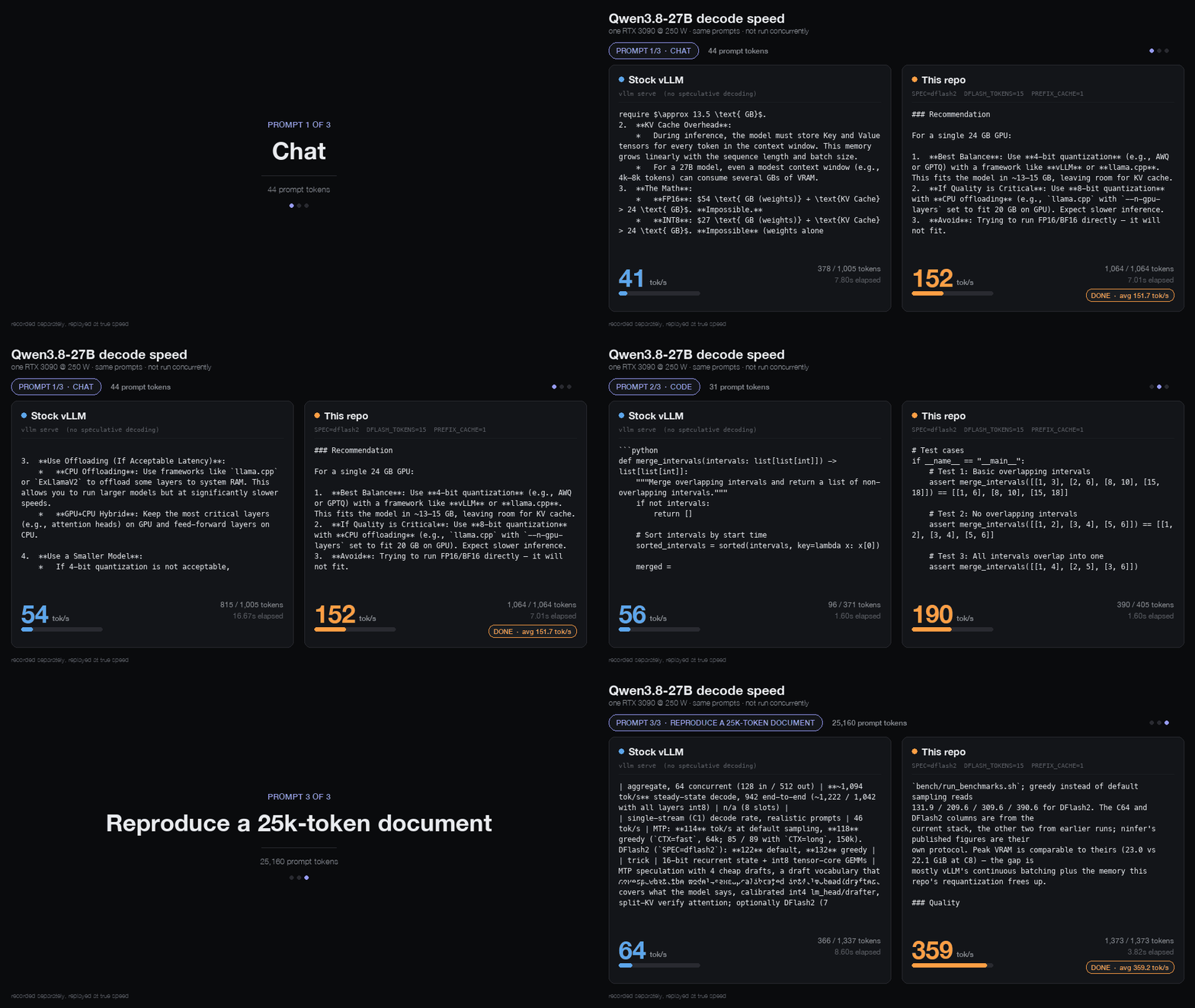
Performance Benchmark: From 46 to 381 tok/s
To what extent is speculative decoding used in this solution? Measured step-by-step:
No speculation (baseline)          : 46 tok/s
+ MTP draft head optimization      : 118 tok/s
+ DFlash2 block drafter            : 132 tok/s
+ Context lookup drafting          : 133 tok/s (chat prompts)
+ Verification block expanded to 16 tokens: 381 tok/s (25K document reproduction scenario)
The number 381 needs separate clarification. DFlash2 was trained to propose only 7 drafts at a time, but the author discovered that the verification block size doesn't have to match the draft count: If the model's response heavily references text already present in the prompt (RAG Q&A, instructed rewriting, code assistant), then the remaining verification slots can be directly filled with tokens appearing in the context—these "drafts" are zero-cost and have an extremely high hit rate. In the 25K document reproduction scenario, each verification step accepted an average of 15/16 tokens, boosting speed from 260 → 382 tok/s.
Therefore, 381 is not a universal speed. For ordinary chat prompts, the same configuration yields about 133 tok/s.
Reproducibility: 2.28× Speedup Verified
Independent developer hankin reproduced this solution on another machine with another 3090 card, conducting a strict on/off A/B test with their own set of 10 writing prompts:
| Configuration | Throughput | First Token Latency |
|---|---|---|
| MTP Off | 52.7 tok/s | Almost no change |
| MTP On | 120.0 tok/s | - |
| Speedup Factor | 2.28× | - |
This number falls within the fluctuation range claimed by the repository. The key is: The core benefit of the solution is reproducible on independent hardware. The 2.28× speedup is reproducible.
Quality Cost: Measurable and Small
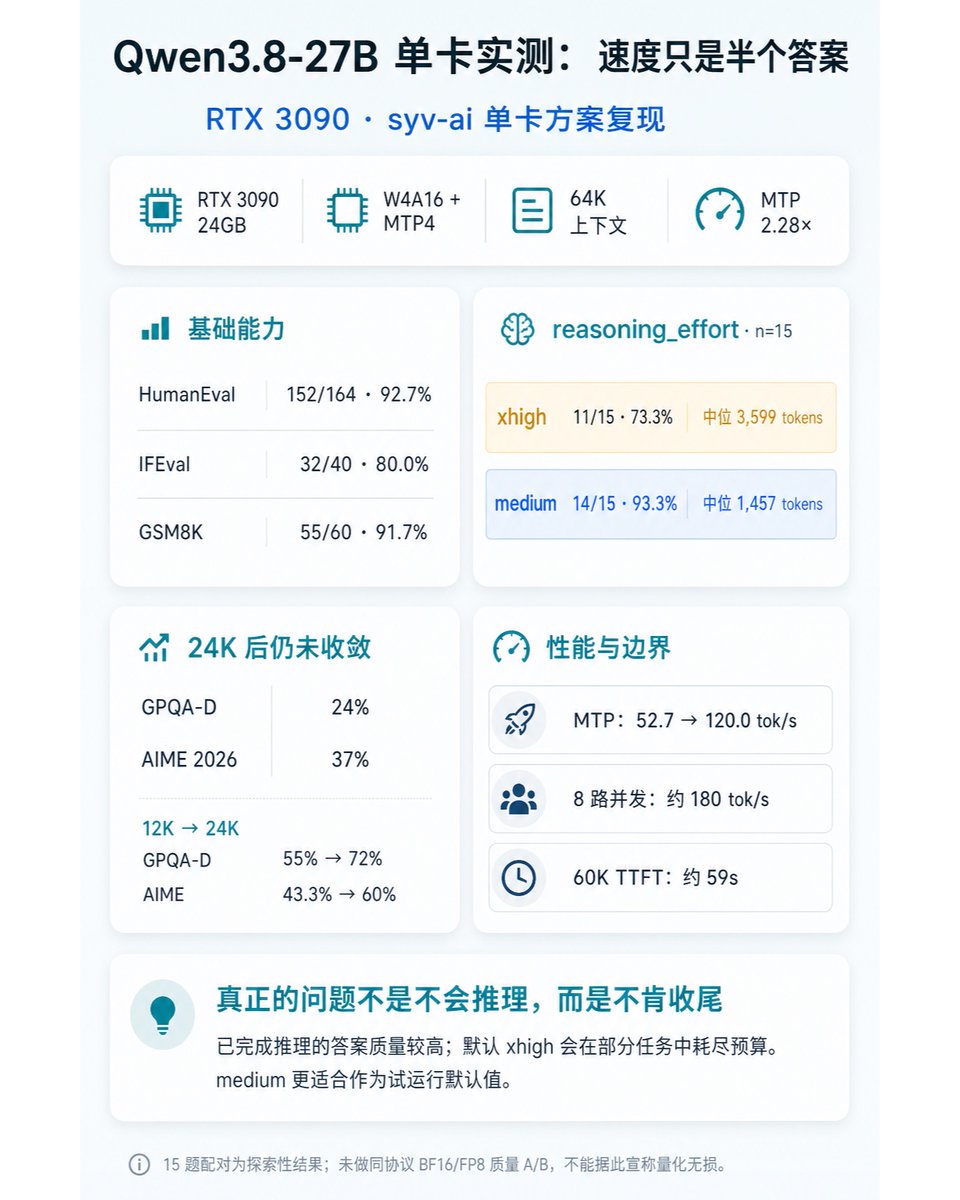
What's the cost of quantizing a BF16 model to 4-bit and adding multiple layers of int8/int4? hankin's real-world test (this weight set + vLLM 0.27.1 + MTP configuration):
| Test | Result | Notes |
|---|---|---|
| HumanEval (164 problems, thinking on) | 92.7% | No significant anomalies observed in code generation |
| IFEval verifiable subset (40 problems, thinking on) | 80.0% | No significant anomalies observed in instruction following |
| GSM8K (60 problems, thinking on) | 91.7% | Completed items at 98.2% |
Conclusion: Within the tested scope, no significant degradation of fundamental capabilities was observed.
However, this is not equivalent to "proven lossless." hankin themselves emphasize: a full, same-protocol A/B test (BF16 vs W4A16 vs speculation off) was not performed. Untested task areas (long-chain code refactoring, low-resource languages, multimodal) cannot be guaranteed.
Part 3: Experience and Hidden Pitfalls
Configuration Requirements Quick Reference
The 27B model, quantized to 4-bit, is about 15-17GB. The experience varies significantly with different VRAM capacities:
| VRAM Spec | Experience Rating | Notes |
|---|---|---|
| 24GB (RTX 3090/4090/5090) | Plenty of headroom | Model + KV cache ~22.3GB, can run 64K context, single stream 120+ tok/s |
| 16GB (RTX 5080/5070Ti) | Runs fine | Context limited, fine for daily chat/code editing |
| 12GB (RTX 4070 Ti) | Barely runs | Q3 quantization ~14.4GB, experience noticeably degraded |
| Mac M5 Max | Respectable | Tested 40+ tok/s |
This week, trending search terms included "What large models can a 4090 deploy?" and "Deploying large models with small VRAM." The people asking these questions aren't just geeks anymore; they're developers troubled by DeepSeek's price hikes.
What It Can Actually Do
Beyond benchmarks, the actual use cases from the community are more telling.
A highly upvoted Reddit post this month (799 upvotes): Using a single 3090 with a standard quantized model. Given a credential and a university name, the model autonomously navigated through layers of campus websites to pull a class schedule—zero human intervention, executing 80 tool calls. Others have had it download videos, extract frames to "watch" content, and install Whisper for transcription.
Many new posts on X: "stopped paying for AI coding today." These aren't proof-of-concepts; they're actual workflows already running.
Three Clear Boundaries
1. The Concurrency Cap is Hard
Service max sequence number is 8:
- 1 stream aggregated: 94.8 tok/s
- 8 streams: 180.4 tok/s
- 16 streams: still 180.4 tok/s (but first token wait time increases from 5.0s to 11.4s)
Recommendation: Keep active inference concurrency under 8; handle waiting queues outside the service.
2. Long Context First Token Cost Cannot Be Ignored
Prefill speed ~1,000 tok/s, TTFT increases linearly with input length:
- 128 token input: 0.61s
- 32K input: 29s
- 60K input: 59s
- 64K returns HTTP 400 (service doesn't crash)
Conclusion: 64K isn't "can't run," but you must accept a first response time approaching a minute for long-document scenarios. Prompt compression, chunked retrieval, and prefix caching are still more important than blindly stuffing 64K.
3. Prefix Caching Benefits Are Severely Underestimated
For a second query on the same 25K document, first token time dropped from 22.4s to 0.56s, with the answer token-by-token unchanged. For scenarios like "load a document once, ask repeatedly" (RAG, code assistants), this benefit impacts the experience more directly than throughput numbers.
The Real Pitfall: The "Thinking Gear" Refuses to Conclude
This is the most valuable finding from this independent evaluation.
Qwen3.8 has thinking mode enabled by default, with reasoning_effort defaulting to xhigh. hankin observed: the model continues reasoning but is reluctant to give a final answer.
With a 12K output budget:
- GPQA-Diamond: Overall accuracy 55%, 43% of questions hit the budget without a final answer
- AIME 2026: Overall accuracy 43.3%, 57% of questions didn't finish within the budget
Extending the budget to 24K improved these to 72% and 60% respectively—but 24% and 37% of questions still didn't converge.
The key is qualitative: Most of these "incomplete" cases aren't repetitive dead loops; the model is still substituting variables, verifying, exploring cases—the reasoning process is healthy, it just won't enter the concluding stage. For questions that did converge, the conditional accuracy for GPQA-D and AIME was 93.4% and 94.7% respectively. The model knows how, but it won't turn in the paper.
What about lowering the thinking gear? hankin ran an exploratory paired test (5 GSM8K, 5 GPQA, 5 AIME questions, each run with xhigh and medium):
| Gear | Accuracy | Median Output Tokens |
|---|---|---|
| xhigh | 11/15 (73.3%) | 3,599 |
| medium | 14/15 (93.3%) | 1,457 |
Medium costs less than half of xhigh, yet accuracy is higher.
This sample is tiny (hankin emphasized: 15 questions, only one sample per gear per question), so the conclusion shouldn't be generalized. But it points to something practical: For your real workload, default xhigh may not be the better default; medium as a starting point for trial runs likely offers much better cost-effectiveness.
Part 4: Advice for Developers
Three Types Who Should Jump In
1. Heavy Users
Running programming agents, batch document processing, automation pipelines daily, with monthly API bills already in the thousands. A used 24GB card pays for itself in months. Local deployment isn't about "saving money" for them, but about "making costs controllable instead of unpredictable."
2. Privacy-Critical Needs
Company data can't leave premises, internal code can't go to the cloud. The open-source 27B is the only accessible "flagship alternative"—large enough in parameters, effective enough, and low enough in deployment barrier.
3. Tinkerers
This week, the community saw submissions for 240K context optimization, custom KV cache proxies, ports to AMD and Huawei NPUs—the process itself is the fun. For them, deployment is the value.
Two Types Who Should Hold Off
1. Light Users
Occasional copywriting, asking questions—the extra money spent after a price hike over a year might not even cover half a 3090. The ROI of token freedom doesn't add up for light users.
2. Those Seeking a "One-and-Done" Solution
Hardware becomes obsolete, models refresh monthly. Buying a card buys the present, not permanence. Someone on V2EX warned back in April: "When a new 40-60B model drops in two months, your hardware won't run it."
The Multi-GPU Trap: Cutting Budget Too Deep Hurts
Low-budget setups can suffer an order-of-magnitude worse experience. One user tried to save money by using dual RTX 5060 Ti 16G cards to pool VRAM for the 27B:
- Measured only 23 tok/s
- Reason: Too small memory bus width + dual-card communication overhead
Enough VRAM ≠ Good Experience — Memory bus width, communication bandwidth, single vs. multi-card setups can create an order-of-magnitude difference in experience for the same model on different hardware.
Cost Structure Analysis
This isn't a "zero-cost" business.
According to industry insiders: Fine-tuning validation uses local cards; for real online inference, buying cards is generally not cost-effective. Two DGX Spark units lose 30k a year; a single 5090 running 24/7 for a year makes 30k (wholesale model, not equal to personal use).
But a hybrid strategy might work:
- Use API for daily lightweight tasks
- Run heavy workloads, private tasks, automation locally
- The essence of token freedom isn't zero cost, but having one more option
Pre-Investment Checklist
If you want to try on your own consumer-grade GPU, here's a pragmatic investment strategy:
- Set default
reasoning_effort=mediumfor thinking requests, allow one controlled retry for the hardest tasks - Keep active concurrency under 8, manage queues at the application layer
- Prioritize retrieval and compression for long documents, don't treat 64K as free capacity
- Differentiate load types: Greedy writing, sampled thinking, long context—don't represent all scenarios with a single throughput number
- Treat the current deployment as a "feature candidate", not a production version that has passed long-term stability acceptance
Final Word
The speed arms race has reached 381 tok/s. Deploying large models on consumer-grade GPUs has moved from "can it be done?" to the middle stage of "how well can it be done?" This solution is still not plug-and-play for the average user — model download, re-quantization, patching, Docker or venv, none of these steps are optional.
But for those willing to tinker, a used former flagship card plus an Apache-2.0 repository can now deliver a local inference experience that was unimaginable a year ago.
The pragmatic posture is: Use API for daily lightweight tasks; run heavy workloads, private tasks, automation locally. The essence of token freedom isn't zero cost, but having one more option.
Unresolved Issues
The problems begin the moment deployment is complete. This evaluation leaves a clear list of untested items:
- Context integrity beyond 64K
- Multimodal capabilities
- Long-term reliability of tool calling
- Failure recovery mechanisms
- Most critical: Full protocol quality comparison between BF16/FP8 and W4A16 on the same card
Quantization equivalence hasn't been rigorously verified. And on the "reasoning behavior" battlefield, the conclusion that medium is more cost-effective than xhigh is based on a 15-question sample; no one has systematically plotted the convergence rate curves across different tasks and gears; the mechanism behind "refusing to conclude" also remains unexplained.
After speed, the next leg of the journey will likely be spent grappling with these more mundane, yet more fundamental, issues.
References
Scan with WeChat to share
Screenshot or long-press the QR code to forward it
📌 Related Posts
DeepSeek Becomes the Kill Line for LLMs
Will DeepSeek's rock-bottom model pricing eliminate OpenAI and Anthropic? The answer is more complex than that.
Leopold Fund Q1 Holdings Analysis: A Full-Scale Bet on AI Infrastructure
A top AI investor, ex-OpenAI researcher Leopold Aschenbrenner, just updated his portfolio—and the data reveals a surprisingly aggressive strategy.
Leopold's Trillion-Dollar Cluster Prediction: Fully Realized Two Years Later
In June 2024, Leopold Aschenbrenner published "Racing to the Trillion-Dollar Cluster," predicting the AI landscape two years ahead while others debated GPT-4.
Subscribe to Updates
Leave your email to get the latest articles and project updates — or subscribe with your favorite RSS reader
Add 0to1.site/en/rss.xml to RSS readers like Feedly or Inoreader
Comments (no account needed, anonymous welcome)
No comments yet — be the first!