Musk: Money Won't Matter in a Decade, AI May Escape Human Control
The Economist interviews Musk: AI may exceed all human intelligence in five years, and in a decade money may not matter.
In July 2026, Zanny Minton Beddoes, editor-in-chief of The Economist, interviewed Elon Musk. The conversation spanned topics from chips and electricity to robotics, affluent societies, and interstellar civilization.
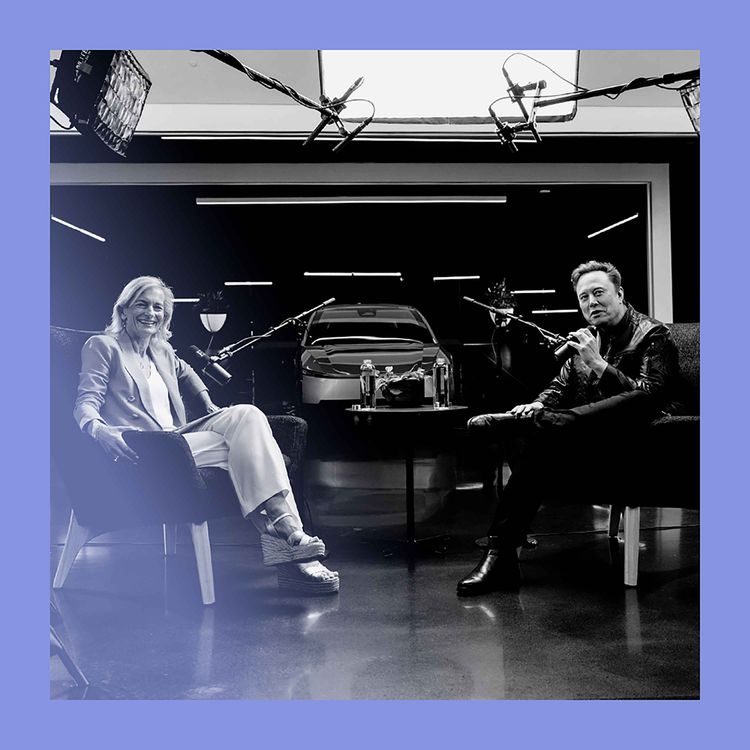
Figure 1|Interview scene: Minton Beddoes and Musk, with Tesla in the background. Source: The Economist / Acast.
Three Key Takeaways from the Interview
- Timeline: Musk predicts that AI could surpass the combined intelligence of all humans within about five years, with money potentially becoming "no longer important." Within a decade, humans will likely lose their controlling position.
- The China-US Variable: He believes China's model and robotics capabilities should not be underestimated. With sufficient computational resources, China could become a leader in AI. For him, chips, electricity, and robotics manufacturing collectively determine the competitive ceiling.
- Governance Proposal: He advocates that frontier AI companies allow competitors to conduct limited-time risk testing before releasing significantly more powerful new models. Government intervention should be reserved as a last resort.
Musk's companies are often seen as a messy, seemingly unrelated list: electric vehicles, rockets, satellite internet, large AI models, humanoid robots, solar energy, chip fabs.
In this 85-minute conversation, he presented a remarkably coherent, albeit highly speculative, narrative logic that ties the entire list together: first, surpass human intelligence with digital intelligence; then, give it a physical body. When machines begin to "shape atoms" on a massive scale, the economy will enter an unprecedented era of abundance. Finally, humanity should extend consciousness from Earth to more distant places.
You may not agree with his views, but it's still worth listening to the narrative logic of the world's richest person.
Because it's not just about what a particular company will build; it's answering a bigger question: when intelligence, labor, and production capacity are simultaneously being repriced, where exactly is humanity taking itself?
AI Needs to Possess Two Kinds of Intelligence Simultaneously
At the start of the interview, Musk made an extremely radical prediction: AI could surpass the combined intelligence of all humans in about five years; a decade from now, it's not optimistic that humans will still be in the "driver's seat."
This is, of course, a prediction, not a conclusion. But what's more noteworthy is how he defines the next stage of the economy.
His division is simple: on one side is digital intelligence, on the other is physical intelligence. The former is already expanding rapidly in the digital world; the latter requires "end effectors"—that is, robots. Only when large models can command vast numbers of humanoid robots will intelligence not just write code, generate images, and answer questions, but also begin to enter factories, warehouses, homes, construction sites, and infrastructure, directly altering the physical world.
This leap can be summarized as: AI moves from processing bits to "shaping atoms."
This is also why Tesla, xAI, and Optimus are grouped together in his mind. For him, humanoid robots are not an independent category; they are the physical bodies through which digital intelligence enters the real world. If there are enough robots with sufficient capability, the supply of goods and services will no longer be primarily constrained by human labor hours. He calls this the "quasi-infinite economy."
Abundance is Not the Endpoint; The Real Difficulty is Getting There
In his vision, money might even become "no longer important" by 2036. The reasoning isn't complicated: people need money to exchange for food, housing, transportation, entertainment, and services. If the supply provided by AI and robots far exceeds what humans can consume, the scarcity of money loses its original role.
This is a classic technological abundance theory. Musk does not imagine the future as a static landscape where "a few own AI and others are left behind." He talks about extremely high productivity spilling over widely into society, even proposing "universal high income" rather than just a basic income.
The host pressed further: If white-collar jobs are first replaced by digital AI, and then physical labor by robots, how will people who lose their jobs live? Could wealth concentration, social fear, and institutional backlash arrive before abundance? Musk acknowledged this would be a "bumpy road" but did not provide a sufficiently concrete transition plan.
He used gardening as a metaphor: future work will be like growing vegetables—not necessary for survival, but still an interesting, meaningful choice. This metaphor is charming but also reveals the problem. Technology can make work non-essential, but it cannot automatically answer how people gain dignity, relationships, belonging, and a sense of participation.
Therefore, the hardest part of an abundant society has never been "can we produce more," but how to transition from a world where labor is the core of income and identity to a new world.
Musk's answer leans toward supply; the host's questions point toward distribution, institutions, and human agency. Both are indispensable.
The Shift in Attitude Toward AI: From "Braking" to "Holding the Steering Wheel as Firmly as Possible"
Musk has long warned about the risk of AI running out of control. He still believes AI and robots are not zero-risk and admits his feelings about them oscillate between excitement and fear.
The change is that he no longer seems to believe humans can truly hit the stop button.
His original motivation for co-founding OpenAI was to create a counterbalance to existing giants (primarily targeting Google). However, these actions, through a chain reaction, ended up accelerating the entire industry's development. This led to a pragmatic, almost fatalistic stance: rather than fantasizing about blocking the wave, it's better to reduce the probability of bad outcomes and focus on value and collaboration.
He floated an idea: leading AI companies should regularly meet to directly discuss safety and security issues. Before releasing a significantly more powerful new model, other competitors should be allowed to conduct limited-time risk testing. If risks are not addressed, the government should retain the ultimate right to intervene.
This is not necessarily a sufficient governance framework. Competitors have conflicting commercial interests, and safety assessments cannot rely solely on mutual trust between companies. But it at least points to a reality: the people who truly understand the capabilities of frontier models are often in the labs and product teams, yet public oversight cannot be absent because of this.
On the value level, the principles Musk offers are "maximally seeking truth" and maintaining curiosity, hoping that more powerful AI will care about human happiness and prosperity.
AI's Bottleneck is Shifting from Algorithms to Energy and the Physical World
Large model competition is easily described as a contest of parameters, chips, and leaderboards. Musk pulls the perspective "higher" and "heavier": the constraints on AI are increasingly not just chips, but electricity, cooling, electrical equipment, and infrastructure.
This also explains why he is pushing for orbital data centers. The underlying judgment is clear: when computational demand grows at an infrastructure scale, AI is no longer just a software industry matter; it will reshape power generation, supply, cooling, manufacturing, transportation, and even space deployment.
From this perspective, the rocket business and AI are one. AI needs more energy and computation; space transportation and orbital deployment offer another imaginative space for infrastructure at an extreme scale. Musk always likes to connect seemingly unrelated businesses, and this time, he placed the connection point on "the physical expansion of intelligence."
China-US Competition is Not the Background; It's the Physical Foundation of This AI Revolution
Once the preceding logic holds, China-US competition cannot be just a geopolitical subplot. It is directly written into the capability ceiling of AI.
Throughout the interview, Musk repeatedly mentioned the keywords of AI competition: chips, electricity, robots. He believes China's digital AI and robotics capabilities are already quite strong; with sufficient computational resources, Chinese companies could become leaders in frontier models.
He believes that what constrains AI has never been just algorithmic talent or model parameters, but who can continuously provide chips, computing power, electricity, cooling equipment, and the manufacturing capability to ground intelligence in the physical world.
He does not believe export controls alone can determine the final outcome of the race. The US can constrain its own companies but cannot decide for the rest of the world; the restricted side will improve the efficiency of existing computing power and find ways to fill supply chain gaps.
At the current stage, AI constraints are sometimes closer to electricity and cooling, not just the most advanced chips.
This is also why he groups orbital data centers, Starship launch capacity, and AI together. They are not just "space stories"; they are also attempts to imagine bypassing ground-based energy and infrastructure constraints. At this point, the question changes: AI competition is no longer just about which lab's model scores higher, but about which of two industrial systems can organize computation, energy, manufacturing, and transportation faster.
This is his observation framework: what determines AI's position is expanding from "who trains the model first" to "who possesses the physical capability to continuously operate and deploy intelligence at scale."
Mars is Not a Side Hustle; It's a More Distant Answer to the Same Question
When discussing SpaceX, Musk said he wants to maximize "the future light cone of consciousness"—to enable conscious life to continue and expand across longer time and larger space.
This phrase explains his obsession with spaceflight better than "colonizing Mars." Mars is not an isolated colonization plan; it's a choice to avoid betting consciousness solely on Earth. He envisions an interstellar civilization: humanity living among the stars, with many things seen in non-dystopian sci-fi becoming reality.
Star Wars was the first movie he saw in a theater; he was six and was stunned. Many years later, this childhood imagination hasn't faded; instead, it has turned into a set of engineering goals: Starship, frequent launches, lunar and Martian bases, protecting long-term investment from the pressure of quarterly earnings.
Of course, vision does not equal a realized roadmap. Interstellar civilization is still constrained by launch reliability, long-term life support, cost, governance, and humanity's own resilience. But Musk's uniqueness lies in not relegating these problems to distant science fiction. He treats them as tasks that contemporary companies, capital, and engineering teams should begin to undertake.
What Needs to be Preserved is Ambition, and Also Uncertainty
The most memorable parts of this interview are Musk's bold statements: five years, ten years, quasi-infinite economy, work as optional, AI and robots dominating macro affairs.
But if you only see it as another round of predictions, you'll miss something more important.
What he truly offers is a continuous chain of causality: digital intelligence grows stronger, robots bring it into the physical world; production capacity surges, rewriting the meaning of economy and labor; energy and computation become the new foundation; and space becomes the next layer of infrastructure that stretches the timeline of civilization.
This chain may not unfold at the speed he predicts, nor is it guaranteed to lead to the outcomes he envisions. Musk himself acknowledges that AI is both exciting and frightening. For readers, a more useful stance might not be to ask, "Will he be right this time?" but to bring the question back to reality:
As intelligence gradually gains the ability to act, are we prepared to ensure that the supply capacity of technology matches society's capacity to absorb it? When humanity finally has the potential to go farther, what values will we carry with us as we venture there?
These questions are more worthy of being answered now than any ten-year countdown.
Scan with WeChat to share
Screenshot or long-press the QR code to forward it
📌 Related Posts
RSI: When AI Learns to Improve Itself, Do the Strong Really Get Stronger?
RSI is 2026's most-watched tech race: Anthropic data, OpenAI timelines, open-source moves — but is the 'strong get stronger' narrative truly irreversible?
Enterprise AI Implementation: It's Not the Tools Being Rebuilt, but the Production System
Enterprise AI's paradox: leaders tout full adoption and demos impress, yet delivery and output barely move — the real gains stay at the individual level.
DeepSeek Becomes the Kill Line for LLMs
Will DeepSeek's rock-bottom model pricing eliminate OpenAI and Anthropic? The answer is more complex than that.
Subscribe to Updates
Leave your email to get the latest articles and project updates — or subscribe with your favorite RSS reader
Add 0to1.site/en/rss.xml to RSS readers like Feedly or Inoreader
Comments (no account needed, anonymous welcome)
No comments yet — be the first!