Will AI Replace the FDE?
Palantir, the company that brought the FDE concept into the world, turned it into an AI product with…
A computer can never be held accountable, therefore a computer must never make a management decision. — IBM, internal training material, 1979
Palantir, the company that brought the FDE concept into the world, turned it into an AI product with its own hands in 2026: the "AI FDE" agent operates Foundry through natural language, executes autonomously, runs in a closed loop, and every action stays bound to the user's existing permissions1. The concept's originator was the first to automate its own execution work.
That sounds like an obituary for FDE. It's actually this chapter's first piece of evidence — it demonstrates with precision exactly what AI eats (tasks) and what it can't (accountability). Separating those two is the premise of everything that follows.
FDE exists in the first place because it sits at the intersection of technical capability, business value, and acceptable cost — only when "AI can do it," "the customer will pay for it," and "the return justifies the investment" are all true at once does a person need to connect it into production. Every step model capability takes forward, every notch inference cost drops, that intersection widens, and the range of business AI can cover on its own grows with it. Understanding this makes clear what the question "will AI replace FDE" is actually asking — not whether the role disappears, but which direction the boundary of that intersection is moving.
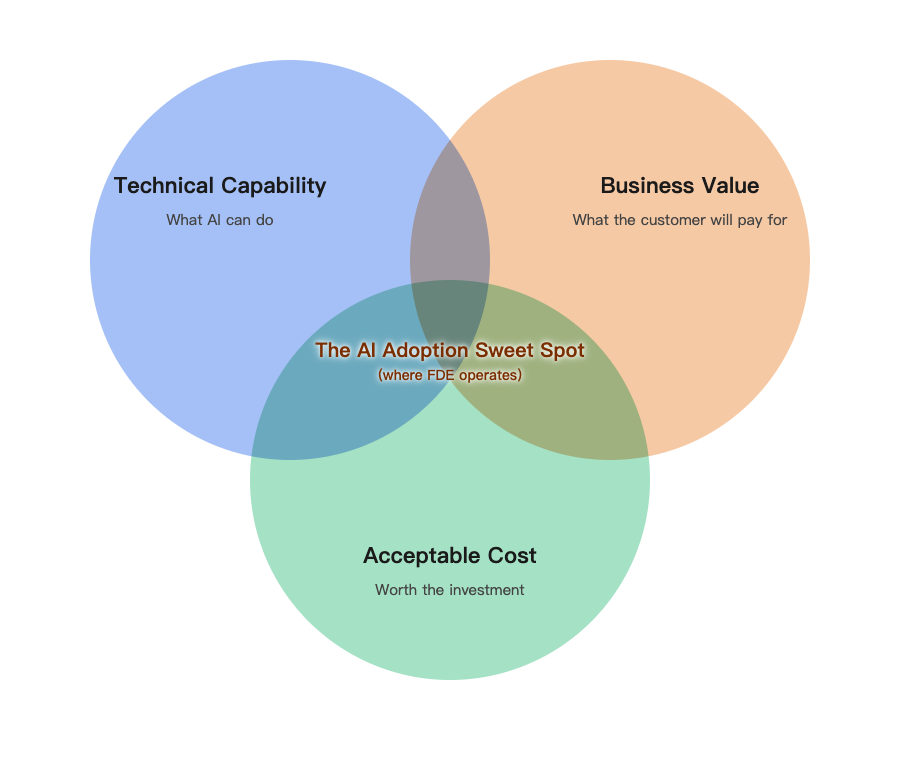
Figure 5-1: No two of technical capability, business value, and acceptable cost are hard to overlap — the hard part is getting all three to overlap at once. That intersection is FDE's operating range.
I. Will AI Replace FDE?
AI never replaces a role — it replaces tasks. Whether a role gets replaced comes down to whether the tasks left over still add up to enough responsibility to hold a job together. Put differently: inside FDE's work, which tasks are being eaten, and which aren't?
Break FDE's work down into a task list, tag each layer, and three tiers emerge:
| Tier | Tasks | Status |
|---|---|---|
| Being automated | Writing integration code, boilerplate connectors, generating first-draft docs, demo materials, routine data processing | Largely eaten |
| Partially automated | Evaluation design, failure classification, comparing solution options, drafting data contracts | AI drafts, humans finalize |
| Hard to automate | Owning accountability, building and maintaining customer trust, vouching for permissions, negotiating sign-off, being accountable for adoption | Essentially untouched |
The first tier's list keeps growing, and faster. That's not a threat — it's leverage. The real dividing line sits in the third tier, and each item there deserves its own "why."
II. Why the Accountability Layer Is Hard to Replace
First, B2B procurement is fundamentally about transferring risk. What a customer buys from an outside team isn't just capability — it's "someone to answer for it if something goes wrong." A model can't sign a contract, can't be held accountable, can't hold permissions — these aren't technical limits, they're legal and organizational ones. An entity that can't be sued can't hold up its end of a contract that says "accountable for the outcome."
Second, permissions belong to people, not to models. Practitioners on the ground keep observing the same thing: an agent only holds the permissions of the human user behind it, and unlike a human colleague, it can't work around a permission wall by asking a favor when it gets stuck — so it often dies at the very first step of enterprise deployment (Chapter 10 unpacks this)2. The permission system trusts "a person plus an identity." AI can only inherit that trust through a person.
Third, judgment is the price of admission for staying in the decision loop. One practitioner nailed it: what a vendor gets paid for is "aesthetic judgment and the ability to build the engineering system around it." He added an observation worth sitting with — once a person's ability falls behind AI's, they can no longer tell good AI output from bad, and end up dominated by it, reduced to an "AI puppet"3. Flip that around, and staying in the decision loop requires your judgment to keep outrunning the tool in your own hands.
Fourth, some information can only be gathered on-site, by a person. One Silicon Valley practitioner made the case this way: he spends his days in meetings and meals with the customer, pulling back the tacit information and unspoken understanding AI can't reach; his evenings turn that information into AI's context. AI can produce several options and a table weighing their trade-offs, but choosing which one — and living with the consequences of that choice — still has to be a person. "We're AI's hands and feet."4
Put the four together, and you get the full logic behind this chapter's epigraph: a computer can never be held accountable, so the responsibility structure has to rest on a person who can be. AI keeps getting better at doing things right — the execution layer. But the responsibility for doing the right things — the judgment-and-guarantee layer — still needs a person who can be trusted, held accountable, and entrusted with permissions to carry it (see Figure 5-2).
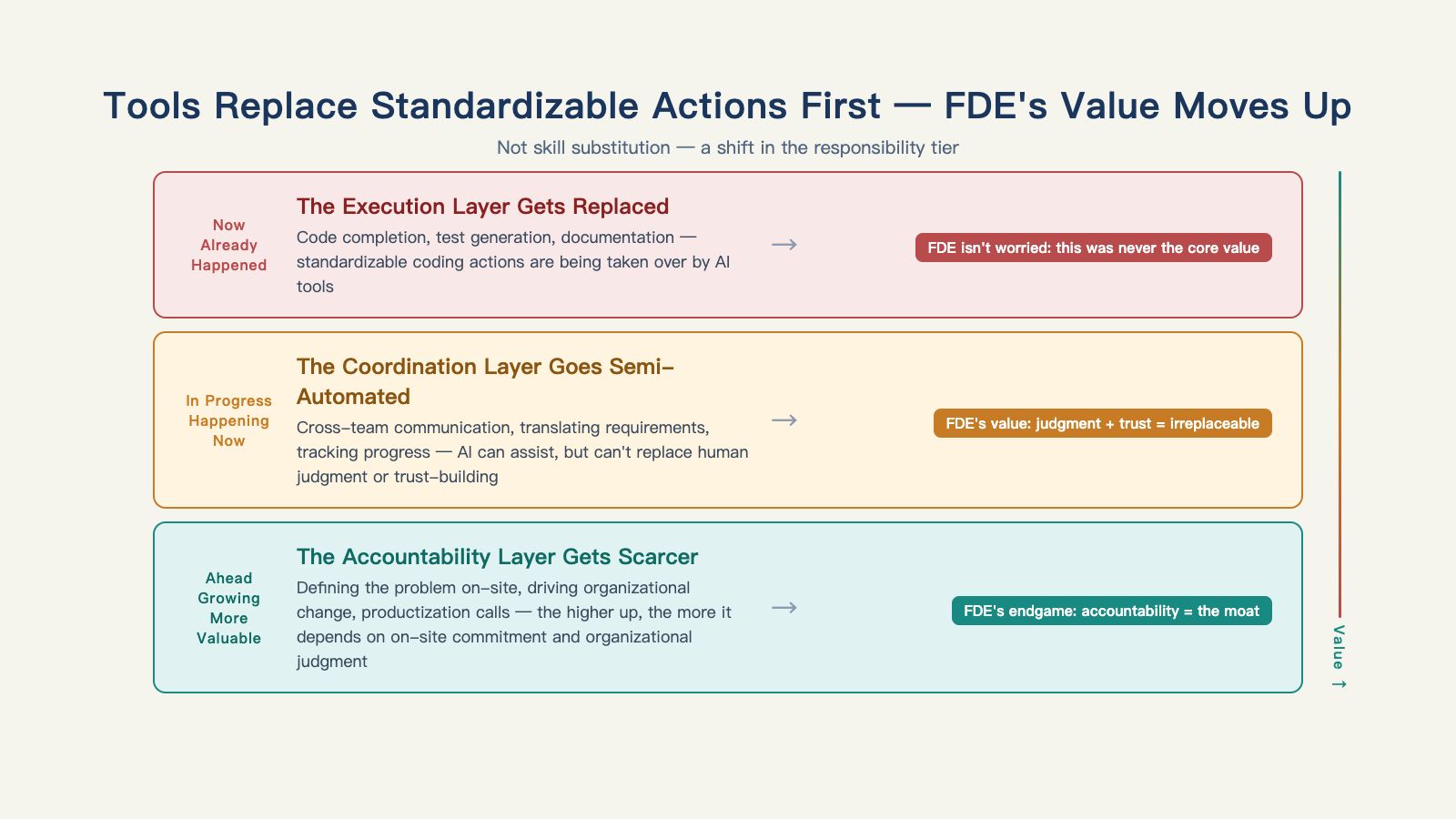
Figure 5-2: Tools replace standardizable actions first; FDE's value shifts upward with field accountability and productization capability.
III. Three Ways of Doing the FDE's Job
An illustration of how FDE work looks across different eras — this scenario is illustrative, not a description of any specific company's actual practice.
The customer says: "Fill in this quarter's sales data. We need it by Monday."
The FDE of ten years ago (human): flies to the customer's site, negotiates data access with IT, writes scripts to pull data from three systems, cleans it, reconciles it, and hands over an Excel file — one week. What he learns — what this customer's data actually looks like, how their processes run — stays in his head.
If it's handed entirely to AI (the technical ceiling, as Palantir's documentation describes it): it receives the instruction in natural language, understands the intent, generates the Foundry operations, executes the data pipeline within the user's existing permissions, logs everything, and pauses for clarification on anomalies — same job, same day. It doesn't know, and doesn't need to know, this customer's organizational history. It inherits the user's permission boundary — and every limitation that boundary carries.
Today's FDE (human plus AI): the person breaks the instruction into pieces AI can execute, and watches the exception and approval points; the execution itself is handed to AI to amplify. The person's day shifts from "writing scripts" to "defining the problem, reviewing the actions, handling exceptions" — exactly the second- and third-tier tasks.
Compare the three, and the conclusion lands on the person: in the combined form, AI amplifies a person's output per unit of time even further — but that amplification only works if the person is standing in the judgment-and-guarantee layer.
Anyone still standing in the execution layer will find less and less room to stand.
IV. How the Structure Evolves
Look at two scales.
Zoom in: the engineer from Chapter 1 juggling ten customers at once is already leaning on tool leverage to cover all ten — an early form of the "human plus AI" combination. The next step is agent leverage: the person handles only judgment, guarantees, and the customer relationship, while agents amplify the execution. His "ten" will turn into a bigger number, but his worth was never staked on that number — it's staked on which layer he stands in.
Zoom out: McGrew has a clever way of putting it — today's AI startups are, in effect, the FDEs of foundation model companies. The model companies build capability; the AI companies pack it into specific industries5. This structure recurses upward, layer after layer: there's always a gap between capability and application — the gap just keeps getting pushed to a higher floor. The job of delivering capability the last mile never disappears. It just resurfaces one floor up.
So what's the endgame? Worth imagining: if that day ever comes — the model hits its limit, stops improving, and cost can't fall any further — the expansion of this intersection stops too.
At that point, FDE would most likely split into two paths: one settling into vertical SaaS, selling standardized software; the other settling into professional consulting, selling standardized service. Today's FDE is neither — precisely because the territory is still expanding and the moment for standardization hasn't arrived, it has to stay in the middle, holding the ground where technology and product can't yet reach. How long that middle ground lasts depends entirely on how much further the model still has to evolve.
V. To Close
Two closing lines, for two kinds of reader.
If you're already doing FDE work: don't stake your worth on the execution layer — it's being eaten right now, not as a future risk, but in the present tense. Move your center of gravity to the judgment-and-guarantee layer: an eye for evaluation, designing sign-off, building trust, the nerve to be held accountable. Chapter 24 goes deep on how to build these.
If you're about to enter the field: the good news is the barrier to entry keeps dropping. The bad news is "knowing how to use the tools" keeps getting cheaper. Get one thing straight before you walk in: come because "I'm willing to carry the responsibility," not because "I know how to use these new toys."
But knowing what it is and knowing how to do it are two different things. The next chapter goes into the field: right after the customer says "we want AI," the first make-or-break task is digging the one problem actually worth solving out of a pile of vague wishes.
Footnotes
-
Palantir Foundry, "AI FDE" product documentation ↩
-
a16z, Box CEO on AI agents and why enterprises can't keep up ↩
-
Turning Point (破局点), Episode 31: "FDE, Chinese Style" ↩
-
Silicon Valley 101, Episode 240: "The Hottest New Job in Silicon Valley — FDE" ↩
-
Y Combinator, "The FDE Playbook for AI Startups" (Bob McGrew) ↩