Why Is Everyone Talking About FDE in 2026?
In May 2026, two things happened between two Mondays. On May 4, Anthropic announced it was forming a…
We always overestimate the change that will occur in the next two years and underestimate the change that will occur in the next ten. — Bill Gates, The Road Ahead (1995)
In May 2026, two things happened between two Mondays. On May 4, Anthropic announced it was forming a delivery joint venture with Blackstone, Hellman & Friedman, and Goldman Sachs1. On May 11, OpenAI set up a holding subsidiary called DeployCo, reportedly funded with over $4 billion and staffed with around 150 FDEs on day one2.
This made a lot of noise. Start with an event timeline to see exactly why FDE exploded in 2026.
I. Timeline: 2003 to 2026
| Date | Event |
|---|---|
| 2003 | Palantir founded; the FDE practice takes shape by the mid-2000s |
| c. 2007 | Early employees embed in customers' classified environments for the first time; on-site delivery takes its recognizable form |
| 2026-02 | Microsoft publishes its Agent Factory white paper; Fujitsu discloses AI-driven development investment in an investor briefing |
| 2026-03-18 | Accenture and Microsoft jointly launch an FDE practice; official language cites "thousands of AI engineers" embedded directly with customers |
| 2026-05-04 | Anthropic forms a delivery joint venture (with Blackstone, H&F, and Goldman Sachs) |
| 2026-05-11 | OpenAI launches DeployCo (a holding subsidiary; reportedly over $4 billion, with roughly 150 FDEs acquired) |
Stretch this table into two curves and it's easier to read: the complexity of integration and adoption has been there since the ERP era and never really went away; AI model capability is just the new variable that only started getting plotted after 2023 (see Figure 4-1).
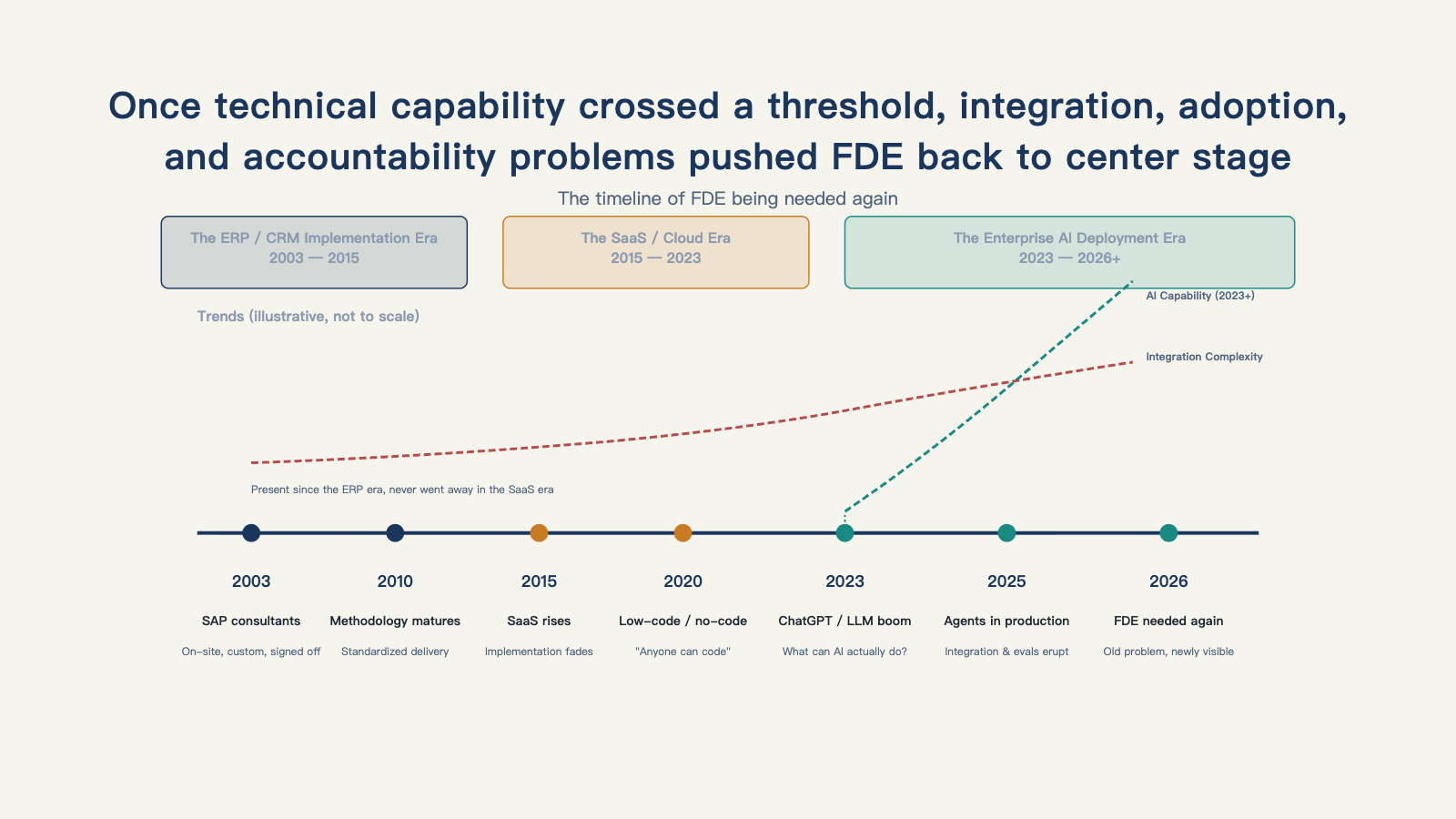
Figure 4-1: Once technical capability crossed a threshold, integration, adoption, and accountability problems pushed FDE back to center stage.
II. Reading the Timeline
Connect the raw facts on the timeline, and a layered reading emerges.
These layers all point to the same thing: consulting giants, model companies, cloud vendors, and the originator of the FDE concept itself — organizations with essentially no overlap — arrived at the same market pain point and the same entry angle almost within the same window. The territory had grown too big for any of them to keep ignoring.
Layer one: the consulting giants move in, and FDE turns from tactic into procurement category. Once Accenture made it a flagship service line3, "forward deployment" stopped being one product company's private playbook and became a standard line item in the enterprise procurement catalog — a buyer could now purchase it like any standard product: budget it, put it out to bid, sign it off. Turning it into a category also raised the bar — everyone who enters after starts from a higher floor.
Layer two: model companies enter, because "just selling an API isn't nearly enough." The most capable model companies building their own delivery organizations amounts to a public admission: model capability alone doesn't translate into customer value. Delivery is the second half of monetizing a model — the enterprise-scale version of the Preface's argument that the block is real.
Layer three: cloud vendors enter too, on the logic that "compute only becomes revenue once it lands in production." Cloud vendors sell compute, but customers only buy it on the premise that they can actually put it to work in production — a pile of idle GPU quota doesn't renew a contract. The motive is identical to the model companies': selling raw capability isn't enough; someone has to connect that capability into the customer's actual business before payment keeps flowing.
Layer four: the originator of the FDE concept starts turning it into an AI product. Palantir's "AI FDE" agent — natural-language operation, closed-loop execution, bound to the user's existing permissions4 — means the FDE concept has begun iterating on itself: the execution work of a human FDE is being packaged into the product.
Stack these layers up, and they answer the question above: the flurry of moves in 2026 wasn't a media event. It was a sequence of actions — the market pricing "delivery capability" as a scarcity independent of "model capability."
III. Why the Productivity Payoff from General-Purpose Technology Always Arrives Late
The reading above answers "who's entering." But an uncomfortable question won't go away: with capital spending across the economy already this large, why hasn't the aggregate productivity number visibly jumped? "AI matters" isn't a good enough answer to that challenge. Set it against a longer technological history, and it actually comes into focus.
Economic historian Paul David documented the lag in factory electrification: electricity entered American factories in the 1880s, and it took roughly forty years before the productivity payoff clearly showed up5. The reason wasn't that factories didn't know how to use electricity — it's that early factories simply swapped the steam engine for an electric motor in place, while keeping the line shafts, belts, and multi-story layouts that had been designed around steam in the first place. Electricity's real advantages — distributed power, independently scheduled processes, more flexible floor plans — only showed up once the factory floor itself was redesigned around electricity. By the historical statistics that paper cites, electric motors accounted for under 5% of driven manufacturing horsepower in the U.S. in 1899, had climbed past half by around 1919, and reached roughly three-quarters by 1929 — swapping the equipment itself wasn't the slow part; redesigning the floor and the workflow around electricity was5.
Personal computers went through the same stage. Economist Robert Solow's endlessly quoted line from a 1987 book review — "You can see the computer age everywhere but in the productivity statistics" — wasn't saying computers were useless. It was saying that companies at the time were using computers as expensive typewriters: type on the computer, print it out, bind it, hand it to a person to file — the process itself never changed6.
Different technologies don't map onto each other mechanically, but this technological history offers a verifiable warning: general-purpose technology tends to get adopted first, get crammed into the old process next, and only shows up as a productivity leap after the organization itself gets redesigned around it.
AI is easy to misread today for exactly this reason: model capability improves monthly, and you can see it. The cost of organizational restructuring — redrawing department boundaries, budgets, permissions, performance metrics — plays out over quarters or years, and you can't.
The productivity number not jumping yet doesn't prove AI has no value — it shows the organizational rebuild hasn't caught up with model capability. Which echoes exactly the previous section's reading: everyone independently putting real money into "delivery" this year is exactly the work of catching organizational restructuring up to speed.
IV. Closing, With a Cool Head
A set of structurally different organizations — consulting giants, model companies, cloud vendors — made real, structural investments in "delivery" within the same window. Why that investment is necessary already has a precedent: the path electricity and the personal computer both walked before it.
Whether the role survives long-term, whether the concept cools off, whether today's entrants come out ahead — that's a separate question. The timeline proves investment, not return. Return is Part Five's ledger, and Chapter 28's final question.
The timeline itself is still holding one thread, buried in layer four: the concept's originator has already turned FDE into an AI product. The people who invented this role are now using AI to replace the role's own execution work. What's left of the role after that is the question that follows directly once the facts are on the table — Chapter 5 answers it head-on.
Footnotes
-
Anthropic, "Building a New Enterprise AI Services Company with Blackstone, Hellman & Friedman, and Goldman Sachs" ↩
-
The New Stack, "Forward Deployed Engineer Is AI's Hottest Job as OpenAI and Google Race to Hire" (Matthew Burns) ↩
-
Accenture Newsroom, "Accenture Launches Microsoft Forward Deployed Engineering Practice to Help Organizations Scale AI Across the Enterprise" ↩
-
Palantir Foundry, "AI FDE" product documentation ↩
-
Paul David, "The Dynamo and the Computer: An Historical Perspective on the Modern Productivity Paradox," American Economic Review 80(2), 1990 ↩ ↩2
-
Robert Solow, "We'd Better Watch Out" (book review), The New York Times Book Review, 1987 ↩