Don't Build Your House on Someone Else's Land: Why I Urge You to Have Your Own Website
Stop building on rented land. Own your website for lasting control and growth, now built with AI in minutes.
A couple of days ago, I had a piece of content that posted fine on WeChat Official Accounts and Xiaohongshu, but Douyin just wouldn't let it go through.
It suddenly hit me—wait, don't I have my own website?
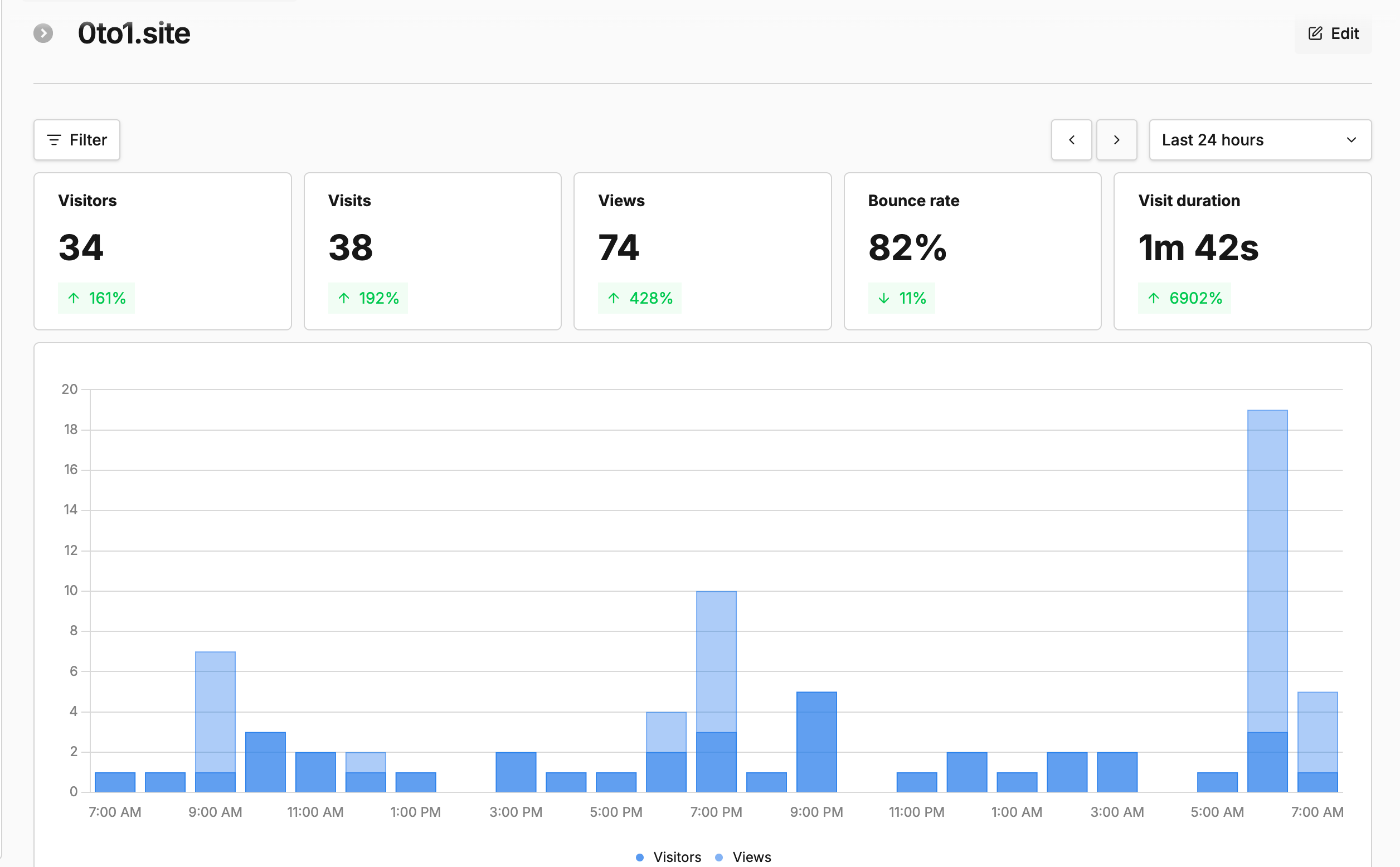
I dug it out, installed a traffic analytics tool (Umami), and checked: over 30 visitors and 70+ pageviews per day.
I only built this website around New Year's and then pretty much left it alone. Getting these numbers was completely unexpected.
So today, I want to seriously discuss: Why I urge you to absolutely have your own website.
1. You've Been Building a House on "Rented Land"
Many people creating content or building a personal brand are used to going straight to platforms—WeChat Official Accounts, Douyin, Xiaohongshu, Weibo. It's convenient, propped up by public traffic, and gets you started quickly.
But you might not realize this is essentially building a house on someone else's land. No matter how nice the house, the land is rented, and the landlord can change the terms anytime.
There are at least three ways the "landlord" can change the deal:
· Every platform has its own lifecycle. Any platform goes through phases: growth (also the growth dividend window), peak, decline, and decay. Accounts are easier to grow during the dividend window. By the peak phase, it gets much harder. You might spend years building an account, only for the platform to decline, rendering all that effort wasted. Think about Sina Blog, Renren (Xiaonei) back in the day—so many people worked hard on them, and then they just vanished. I once had a Zhihu account with over 70,000 followers, but now its views and engagement are worse than a Xiaohongshu account with just a few thousand followers. It's painful to talk about.
· Rules can change overnight. There are limits on posting frequency and format—some platforms are video-only, some only allow image-and-text posts, some only text; some platforms outright forbid funneling traffic to private-domain channels, or have "overly protective" rules that are arbitrarily strict and frustrating.
· An algorithm tweak can zero out your traffic. If the platform's recommendation mechanism changes, your exposure can plummet overnight. Your follower list might look like it's yours, but you can't actually reach them.
To put it bluntly, it's like e-commerce: opening a store on Taobao or Tmall is "platform e-commerce"; building your own independent store is "independent site e-commerce." The store belongs to the platform, the traffic belongs to the platform, the rules belong to the platform. Only the site you build yourself is truly yours.
2. An Independent Site is Your True "Personal Plot"
Your own website is a piece of land you truly own. What's so good about it?
First, no content restrictions. You decide what to write, what to post, and how often. You don't have to cater to any platform's whims.
Second, traffic compounds. When you consistently update your site, its authority gradually builds. The longer you maintain it and the higher the quality, the better its search ranking. A social media post on a platform might have a lifespan of 48 hours, sinking into obscurity in a few days. An article on your website, however, can rank in search results for years, continuously accumulating backlinks and bringing you traffic long after. This is "SEO compounding."
Third, monetization is more flexible. The avenues are wider than you think, and you're not strangled by platform rules:
- Paid Subscriptions—Memberships, columns, Newsletters, letting loyal readers pay you consistently.
- Advertising—Google Ads, product distribution/affiliate marketing (earning affiliate commissions), generating passive income.
- Tips/Sponsorships—Add a "Buy Me a Coffee" button; readers who appreciate your work can easily buy you a virtual coffee.
- Promote your own projects/products—If you have your own products, courses, services, or open-source projects, your website is their permanent, never-delisted display window and conversion point. Posting a link on a platform might get it throttled or hidden, but on your own site, you can promote however you want, turning visitors directly into your own customers and building word-of-mouth.
Fourth, longevity. Websites have existed since the dawn of the internet. Their traffic comes from search—people actively looking for you, not exposure doled out by a platform. There's no risk of "the platform dying and you dying with it."
Fifth, deeper relationships. Users on platforms are often one-time visitors in a "search-buy-leave" pattern; you can't retain them or contact them. An independent site is different—you can use RSS or email subscriptions to push content, or bring them into your private-domain community, fostering ongoing dialogue and gradually building repeat purchase rates and Lifetime Value (LTV). One-time customers aren't brand assets; people who keep coming back are your true users.
Sixth, the data is yours. Data from platforms is fragmented, anonymized, and owned by the platform, making it hard to see the full picture. Independent site data is full-funnel, identifiable, and accumulative—from clicks, cart additions, conversions, returns to after-sales, forming complete user profiles that support precise marketing and product optimization. Like the Umami I installed: self-hosted, self-controlled, and it can track different traffic sources. You see which channels work and focus on them. Data is the fuel for growth; your independent site is your "data mine."
3. The Cost of Building a House Now is Negligible
In the past, building a website required coding, buying templates, configuring servers, which deterred many. Now it's completely different:
Just ask Codex or Claude Code to help you develop one; you can have a site up in minutes. SEO, RSS subscriptions, email notifications can all be configured along the way. The overall cost is so low it's almost negligible.
That's exactly what I did—around New Year's, some content couldn't be posted on certain platforms, so in frustration, I made my own website and then left it alone. It wasn't until a couple of days ago that I remembered to check, only to find it had "grown" on its own to over 30 visitors and 70+ pageviews.
4. A Smarter Strategy: Publish on Your Site First, Then Distribute
My suggestion isn't to "abandon platforms," but to change the priority:
Publish content on your own website first, then distribute it across various platforms.
This strategy has a specific name overseas: POSSE—Publish on your Own Site, Syndicate Elsewhere. It doesn't mean giving up social platforms; it makes them work for you instead.
Treat your website as your "base" and "content source," and treat platforms like WeChat Official Accounts, Douyin, and Xiaohongshu as "tentacles" and "distribution channels." Platforms are responsible for user acquisition and traffic, ultimately directing people back to your own website—where you call the shots. On your site, analytics, design, lead capture, structured data are all under your control, with no ads or algorithm filtering.
This way, you enjoy the public traffic of platforms without betting your entire livelihood on any single one. If a platform truly dies one day, your content and reader relationships are still safely stored on your own website.
Another small tip: leverage GitHub to build your influence simultaneously. Open-source your work, share consistently, forming a multi-channel personal brand matrix.
5. The Cunning Rabbit Has Three Burrows
To be honest, relying entirely on one platform is handing your fate over to someone else.
Just like the cunning rabbit has three burrows. Building your own independent site is creating a piece of territory that can never be taken from you.
Ultimately, platforms are borrowed strength; you must eventually return to your own independent site—it's more controllable and better at truly funneling and solidifying traffic into something you own.
Moreover, as large model search becomes increasingly common, when AI answers questions, it cites content from "people who have their own websites." Without your own site, even if AI wanted to cite you, it wouldn't know where to look.
My personal website is 0to1.site; feel free to visit. I genuinely suggest you take the time to build one for yourself too—it's not expensive, but it's valuable.
References
- IndieWeb: Own Your Data — The original initiative from the IndieWeb community about "owning your data," the ideological source for the "data is yours" argument in this article.
- Don't Build on Rented Land — Kevin LexBlog — A classic article in the legal blogging circle, one of the earliest to thoroughly explain the metaphor of "building on rented land."
- POSSE Strategy Explanation — A systematic introduction to the "Publish on your Own Site, Syndicate Elsewhere" strategy.
Scan with WeChat to share
Screenshot or long-press the QR code to forward it
📌 Related Posts
From Corporate Founder to Indie Developer: AI Tools Help Him Earn $500,000 Annually
Hello everyone! Today, I’d like to share an incredibly inspiring real-life story about a founder from a well-known company who transitioned into an indie.
Reddit Cold-Start Failure: 1 Upvote and 5 Hard Lessons for Global Entrepreneurs
For indie developers and entrepreneurs, Reddit is a prime platform to test products and gain early users—but a poorly prepared launch can turn disastrous.
Anthropic Founder's Handbook
Anthropic's 35-page startup guide reveals AI now eliminates three major barriers: funding, talent, and technical skills.
Subscribe to Updates
Leave your email to get the latest articles and project updates — or subscribe with your favorite RSS reader
Add 0to1.site/en/rss.xml to RSS readers like Feedly or Inoreader
Comments (no account needed, anonymous welcome)
No comments yet — be the first!