How Should an Engineer Make the Transition to FDE?
Two thirty-day promises.
Scars signal skin in the game. — Nassim Nicholas Taleb, Skin in the Game
Two thirty-day promises.
One lives on a Silicon Valley social platform: a post titled "How to Become a Million-Dollar Forward Deployed Engineer in 30 Days," 360,000 views, complete with a thirty-day roadmap and salary tiers.1 A Chinese "FDE training" syllabus can be summed up in one phrase: hard to even describe. Lesson one teaches how to print Hello World on your computer, not a shred of hands-on delivery training anywhere in the course, a lineup of "famous instructors," and a price tag of twenty thousand yuan.2
The anxiety around transitioning is real, and the training market that grew up around that anxiety is the first place the bubble is inflating. This chapter won't repeat "how to prepare" — that topic has been written to death. It only covers two questions people usually skip: how to judge it when you're the one being tapped for the move, and what employers are actually looking for when they hire.
I. Paths of Transition
Five backgrounds, five different shortcuts, five different traps. Coming from backend: engineering delivery is already there; what's missing is reconstructing the business and driving the organization. Coming from product management: the business and organizational grounding is there; what's missing is end-to-end engineering feel. Coming from consulting: customer communication was never the problem — the hardest step is turning "hand over a proposal" into "hand over a whole system that runs." Coming from data analysis: the eval and data grounding is there; what's missing is system integration and owning accountability. Coming from algorithm engineering: the most common mistake is overrating the model and underrating integration — of Chapter 9's eight walls, the model doesn't even count as one of them; integration and data permissions are the walls you hit first.
One line applies across every background: the ticket into this transition isn't finishing a course — it's producing one piece of delivery evidence you can actually show someone.
II. Tapped for a Transfer: Opportunity or Trap?
Most writing on transitioning assumes "you want to move." In reality, a lot of transitions are pushed from above. One backend engineer at a foreign company wrote about it plainly: he was fluent with AI tools and a decent communicator on his R&D team, so his manager wanted to move him into FDE — but he liked the technical work, and "the moment I think about going down this path, it feels like I'm drifting further and further from the technology," a reluctance he couldn't shake.3 Facing this, the move isn't to rush toward "accept" or "refuse" — it's to run three checks first.
Step one, run the three-way test, using the standard from Chapter 2. Ask three questions: Does my code go to production? Where does field experience flow back to? What does this role get measured on? Get clear answers to all three, and it's a real FDE role; hedge, or hear only "let's just see how it goes," and it's probably implementation wearing a new label.
Step two, test whether the organization actually backs it. Does the company have a real business problem it needs solved, or is this just "everyone else has one, so we should too"? Is there a business-side sponsor willing to invest? There's a more direct signal too: which department the role reports into, and to whom. Report into product or engineering, with revenue booked against the platform product, and FDE success equals product adoption. Report into sales or delivery, billed by the day, and the role easily degrades into a presales labor pool — a fancier name for implementation.45 In an interview, you can ask outright who the FDE role reports to — more reliable than guessing yourself. A solo FDE — the only one in the whole company, no feedback channel, no business-side interface — is a high-risk setup: succeed, and it's your personal win; fail, and there's no organizational backstop.
Step three, test whether you're actually a fit (the twelve questions from Chapter 24). The score itself isn't the point — what matters is whether that worry about "drifting from technology" holds up. A real FDE role's engineering content isn't thin — Chapter 23's three-quarters-time-on-engineering figure is the evidence. What you'd actually be drifting from is deep-focus, algorithm-research-style technical work — so first figure out which kind of "technology" you actually care about.
Run all three, and there are only three outcomes: pass all three, and go all in; the role is real but organizational support is weak, so negotiate boundaries — get a business-side interface and a feedback mechanism in place before accepting; the role itself isn't real, so switch internal tracks instead — don't bet your career on a title that's just old work in new clothes.
III. What Employers Actually Look For
There's another angle people often skip: what makes a company willing to give someone changing careers a shot. That decides where the transitioning engineer should actually spend their effort.
Evidence that counts as a signal: a real delivery made for an internal user — real users, real operational traces after go-live; a track record inside a cross-departmental project — meeting notes showing you were the one who saw it through; having maintained a system after it went live — handled alerts, taken complaints, shipped iterations.
Evidence that doesn't count as a signal: course certificates; a demo reel with no real users; "I've learned framework X" — frameworks go stale fast, meta-capability is what sticks (this is Chapter 24's two-layer structure showing up in hiring: what an employer is buying isn't which framework you know, it's whether you've made an architectural call yourself when nobody handed you a spec) (see Figure 25-1).
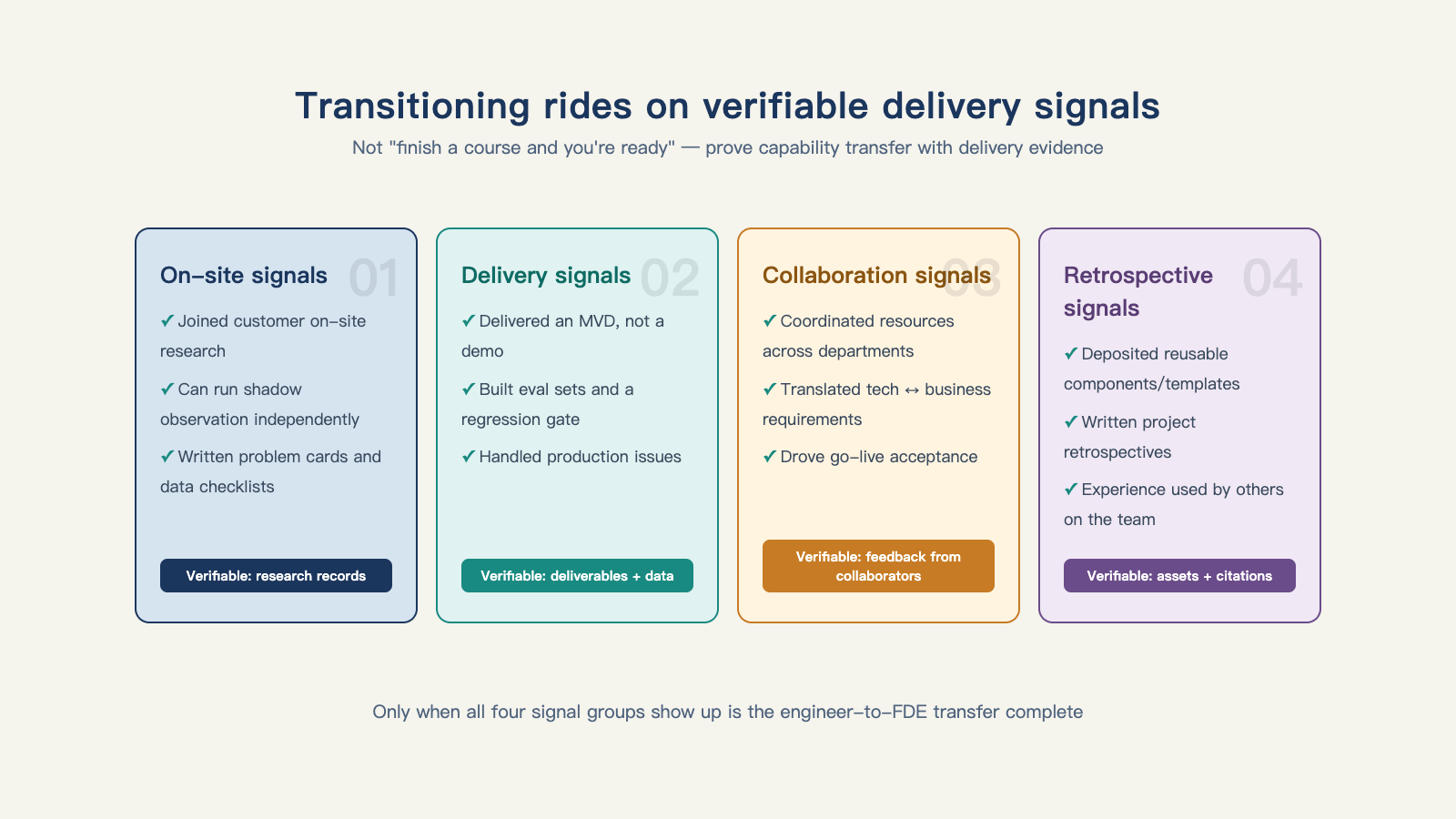
Figure 25-1: Transitioning rides on a chain of verifiable delivery signals, not on writing the job title into your résumé.
So "finish learning first, act later" is a strategic mistake: learning is necessary, but what learning produces — certificates, course assignments — is exactly the least convincing signal. Producing one piece of delivery evidence you can show someone, in the job you already have, is worth more than any course — which is also why the three trials from Chapter 23, Section VII (internal delivery, a customer meeting, running a live system for a month) double as a transitioning engineer's résumé-building project.
IV. The Training Market: How to Tell If It's Real
Back to the two "thirty days" from the opening. The Chinese and American samples are saying the same thing: transition training is the first link in this chain where the bubble inflates — the anxiety shows up before the demand matures, and anxiety has always been the easiest thing to sell.12
Choosing a course or a bootcamp comes down to one hard test: is there real-project practice. Training built on real customers, real delivery, real acceptance is worth the price even when it's expensive; without that, the prettier the syllabus, the more suspicious you should be — "thirty days to a million dollars" and "lesson one, print Hello World" are, underneath, the same business. One more note of caution: the practitioner quoted above who criticizes the training bubble runs his own bootcamp, and its selling point is exactly "real-project practice" — his opinion lines up with his own business interest, so hear the argument on its merits, but keep a clear head.2
V. The Cheapest Way to Test It
You don't need to quit to test this path — the three scenarios from Chapter 23, Section VII (internal delivery, a cross-departmental project, a customer meeting), are already the cheapest way to try it out; there's no need to design a separate approach. Run them, and you'll walk away with three things at once: a piece of evidence you can show someone (Section III), an answer to whether you're a fit (Chapter 24), and an answer to whether you'd actually be drifting from technology (Section II).
VI. Pay Cuts and Expectations
One last honest question: does moving into this role mean taking a pay cut? The market can't give a trustworthy number — pricing for this transition is still in a chaotic phase; the same city, the same title, and the spread can be absurd. Instead of a number, here's a structural judgment: in a chaotic phase, the difference between individuals matters more than the difference between titles — how solid that piece of delivery evidence is affects your market value more than the three letters "FDE" ever will. So the anchor for any negotiation shouldn't be the title — it should be the evidence. Walking in with a record of internal delivery and walking in with the sentence "I can do FDE work" put you in two entirely different positions.
The individual side of the path is complete. Now look across the table: when does a company need its first person like this, where do they put them, and how does the team grow from there — the next chapter takes the employer's side of the question.
Footnotes
-
@gregisenberg on X, "How to Become a Million-Dollar Forward Deployed Engineer in 30 Days" ↩ ↩2
-
Turning Point (破局点), Episode 31: "FDE, Chinese Style" ↩ ↩2 ↩3
-
"Moving from R&D to FDE: A Step Up, or Just a Rebrand as Implementation?" (linux.do thread) ↩
-
"100 Questions About FDE" (open-source ebook) ↩
-
Fan Bing, Forward Deployed Engineer (FDE) (XDash open-source book) ↩